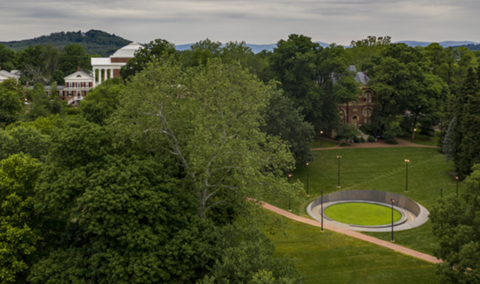
On the second day of our Sister Trip, Jo and I found another memento of Charlottesville’s past, The Memorial to Enslaved Laborers (MEL). The University of Virginia, like many important institutions and buildings in the south, was built by people kept in slavery. This monument—a circle of local “Virginia Mist” granite — commemorates the more than 4000 African Americans who from 1817 until Emancipation laid the bricks, constructed the columns, and planted the trees that made this one of the most beautiful campuses in the world.
For almost two centuries, their labor was ignored and their contributions devalued. In fact, historians noted that parts of the campus were deliberately designed as “swales” (lowered circular areas) to hide the African American workers from view. Now, on the grassy area that connects the campus to the downtown, this new monument transforms that lowered circle into a symbol of connection of past and future. As the architects explain, “Oriented northward toward the symbolic path to freedom, MEL transforms the historical usage of the landscape as a tool of domination by becoming an open and welcoming place for those seeking truth and justice.”
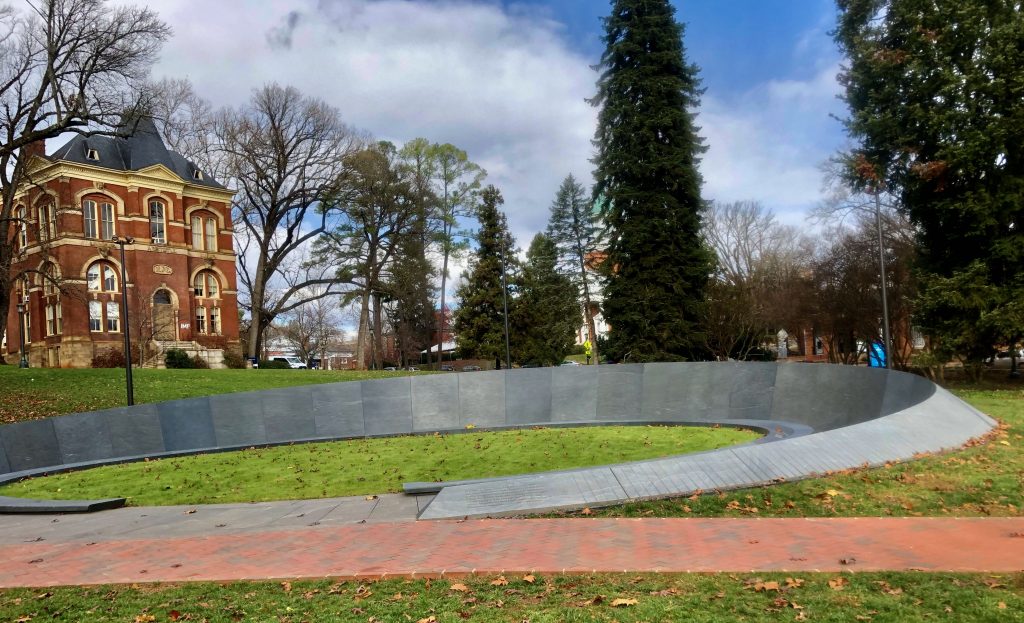
This monument is a series of concentric granite rings, with a concave wall and a watertable with plaques marking the history of the workers, starting when enslaved Africans arriving in Virginia. The water flowing over this timeline represents the Middle Passage but also the rivers that carried escapees to the north and freedom. The circle also represents an African dance, the “Ring Shout,” which expresses liberation and community.
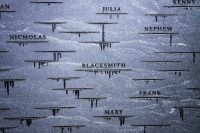
 Unfortunately, the lack of recognition meant that many of these workers’ names went unrecorded. This is poignantly expressed in the monument. Etched in the granite are some first names of hundreds of workers—Mathilda, Peter– and others whose names aren’t known but are designated by their occupation—carpenter, maid. The architects conclude, “The Memorial’s commemorative forms and historical inscriptions acknowledge the dualities of enslavement—the pain of bondage and hope for the future. It celebrates the bonds of community that nurtured resistance and resilience to the dehumanizing violence that shaped the everyday experience of enslaved life at UVA.”
This memorial also represents the complexity and paradox of American history. This university build by forced labor was also the university founded by the man who wrote these words:
We hold these truths to be self-evident, that all men are created equal, that they are endowed by their Creator with certain unalienable Rights, that among these are Life, Liberty and the pursuit of Happiness….
As we approach the 250th anniversary of that stirring if too-restricted declaration, this monument to the enslaved laborers is a reminder of what Solomon Burke sang long ago:
Well, you better listen, my sisters and brothers,
’cause if you do, you can hear
There are voices still calling across the years,
And they’re all crying across the ocean and they’re crying across the land,
And they will ’til we all come to understand:
None of us are free, none of us are free
None of us are free, if one of us are chained, none of us are free.