
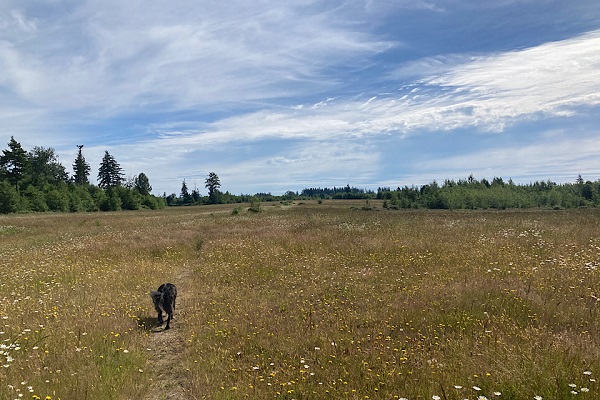
In which my hero-husband Thor Hansen turns his scientist’s eye toward our local fields of grasses.
I have been retired as Professor of Paleontology and Geology for 8 years, and my days have settled into a pleasant rhythm of gardening (i.e. pulling weeds), doing whatever projects Sara cooks up, and walking our dog Reo. We are fortunate to have about 400 acres of undeveloped fields and woods right across the road, where the locals walk their pets. To satisfy my natural curiosity, and to ward off dementia, I use apps on my phone to identify bird songs and the larger plants, which I try to memorize. I enjoy mansplaining to Sara when she joins us…. “Look Sara, see that flower that looks like a dandelion. It is not a dandelion, it is a Cat’s Ear. They are in the same family, though.” She won’t admit it, but she loves these little lessons.
On a typical walk with Reo, I will start in the woods and note the Alder tree, the Western Red Cedar, Salmonberry, and perhaps a Trillium. In a few hundred yards, Reo and I will emerge onto a beautiful grassy field.
Here are a few of the flowers. Some I can remember from previous years, some I need to look up again. Depending on the month, I will see Ox-Eye Daisy, St. John’s Wort, Bird’s Foot Trefoil, and others.
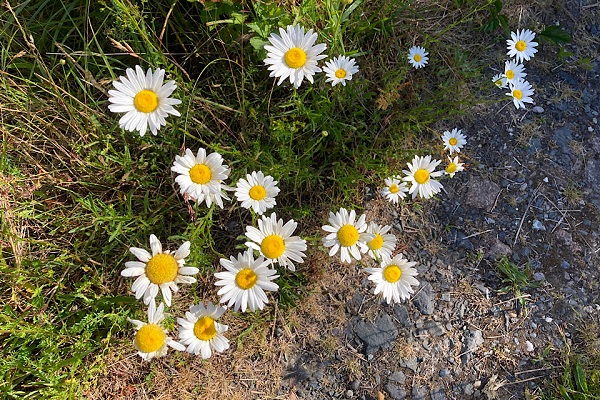
Ox-Eye Daisy
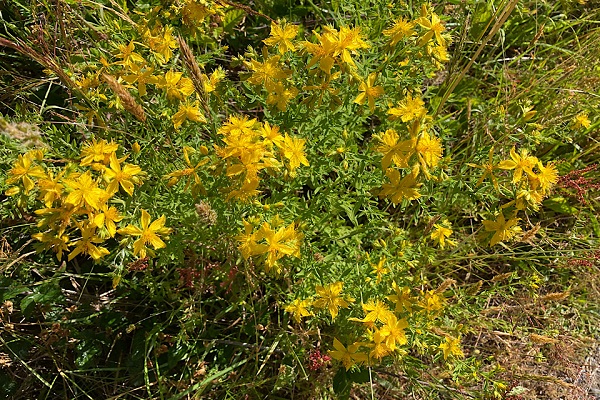
St. John’s Wort
There are a lot of flowers and they are very pretty, but they make up a minor percentage of the vegetation in the field. Most of the field is just… grass. I have never given grass a lot of thought. It is pretty in a lawn. I mow it when it gets tall. I water it when it is brown. But it is still just “grass.” I can name the flowers in my yard, but I have no idea what kind of grass it is. In the fields in the early spring, the grass is like a short green lawn with no distinguishing features that I can detect. But in summer the grasses grow to their full height and blossom, and I can see that there is quite a variety of them. So, last week I decided I had ignored grasses for too long, and I was going to man up and identify them. Oh My God, did I fall into a rabbit hole! I pulled out the app and in 20 minutes I found the following: Orchard Grass, Common Brome, Yorkshire Fog, Sweet Vernall Grass, Bent Grass, Timothy, Feathertop Reed Grass, Drooping Brome, Squirreltail, Crested Dog’s-Tail, Reed Canary Grass, Meadow Barley, Tall Oat Grass, and Blue Grama. (You gotta love those names. Crested Dog’s-Tail? Yorkshire Fog?) There were several more that the app just gave up on and called “grass.” Over 14 different species in a space the size of an average bedroom.
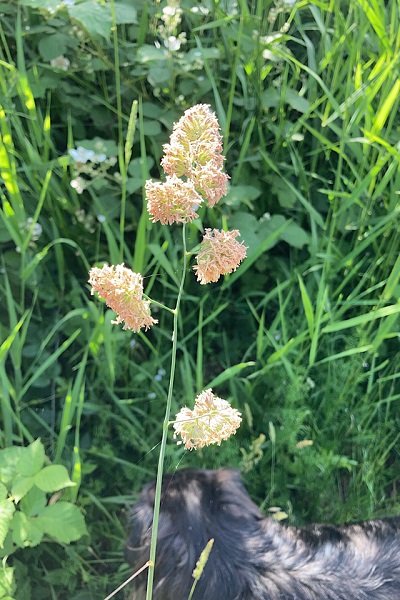
Orchard Grass
I’m posting my complete blog entries on my author website at www.sarastamey.com, where you can finish this episode and enjoy all the accompanying photos. Please continue reading by clicking on the link below, then you can return here (use “go back” arrow above) to comment, ask questions, or join a conversation. We love your responses!
https://sarastamey.com/a-rambling-writer-guest-post-thor-ponders-grasses/
*****
You will find The Rambling Writer’s blog posts here every Saturday. Sara’s latest novel from Book View Café is Pause, a First Place winner of the Chanticleer Somerset Award and an International Pulpwood Queens Book Club selection. “A must-read novel about friendship, love, and killer hot flashes.” (Mindy Klasky). It’s also a love letter to the stunning beauty of her native Pacific Northwest wild places. Sign up for her quarterly email newsletter at www.sarastamey.com

1 thought on “A Rambling Writer Guest Post: Thor Ponders Grasses”
I do enjoy DocThor’s “mansplaining.” His students adored him for his offbeat humor, which he employed very effectively to lure them into learning the scientific method.