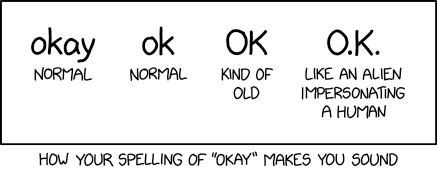
America has given the world many amazing inventions, good and bad—the lightbulb, the atomic bomb, the airplane, Kraft Mac & Cheese. But I’m going to argue that the most pervasive and probably the most useful isn’t a machine or a snack food, but a word.
Now it’s the most widely used word in the world.
Here’s a hint. It has two spellings—one an abbreviation, and the other a phonetic spelling of that abbreviation.
Okay, okay, I’ll tell you.
But first, notice when I post the question, I automatically responded the very way people all over the world would speak in the affirmative.
Okay!
Yes, “okay” or “OK” is probably the most popular word of all—an American-English word used by English speakers and non-English people all over the world.
How pervasive is it? Well, my widely-travelled husband has heard natives say it in Tonga and Pulau (two of the most distant places on earth). He has long visited Basa, a remote Himalayan village—in fact, he was one of the first Westerners to enter the settlement. And those the Basa villagers? Well, now they are OKAY! I can’t be sure of this, but I suspect Jeff actually brought that viral word to the village, and now I often see that word when I read Facebook posts by Niru Rai and Ganesh Rai and Chhiri Rai (yes, they now have social media, and yes, Nepali surnames are often identify their ethnicity, so there are many “Rais” in Basa).
Professor Allan Metcalf chronicled the origins of the all-purpose word in his book OK: The Improbable Story of America’s Greatest Word (2010). His account indicates that “okay” is American in origin. He and historian Allen Walker Read tracked the initial print appearance to jocular slang exchanges newspapers in New England about 1830. I once worked as a researcher on the history of newspapers in Indiana, and I can confirm that 19th Century newspaper articles were playful and wacky, and often invented wordplay games. One popular trend was the use of deliberate misspellings, similar to that early Web invention, “lulz” or Lol-cat-speak. And then that was paired with another popular trend of turning common phrases into abbreviations. So “all correct” became “oll korect” and then became “O.K.”
Then that was taken up by, of all people, a presidential candidate. Martin Van Buren was the 8th president, and the first to be born in “the United States” (the first born after the Revolution, that is). He came from the town of Kinderhook, NY, and when he campaigned, he called himself “Old Kinderhook” or O.K. His supporters created “OK Clubs”, and advertisements declared, “We’re O.K.!”
Maybe because of this campaign and the rise of mass communication (that is, telegraphy), the abbreviation became common and writers began spelling it out as a word. Metcalf found an early reference by Louisa May Alcott, where the practical Amy uses that most practical word almost like a verbal shrug:
One of us must marry well. Meg didn’t, Jo won’t, Beth can’t yet, so I shall, and make everything okay all round.
— Little Women, 1868-9
Since then, the meaning of this word has expanded, and so has its role in a sentence. “Okay” can be used as five of the nine main parts of speech. Let’s start with the most common one—the interjection or discourse marker, used at the start or end of a sentence (or by itself) as an independent request or affirmation, acceptance, or agreement.
“Just do what I say, okay?”
“Okay, folks, it’s time to start the meeting.
—
Then there’s the modifier usage, as an adjective:
“It was only an okay date, nothing special.”
… and as an adverb:
“The printer seems to be working okay now.”
—
And now we sometimes use it as a verb:
“Can you okay this purchase order for me?”
So of course it then quickly became a noun:
“I need your okay before I can order that new printer.”
—
Punctuation can change the meaning also:
“This might sting a bit, okay?”
“Okay! Let’s party!”
“Okay… I guess.”
No wonder this little word has crept into so many other languages. It’s short, sweet, and oh, so useful.
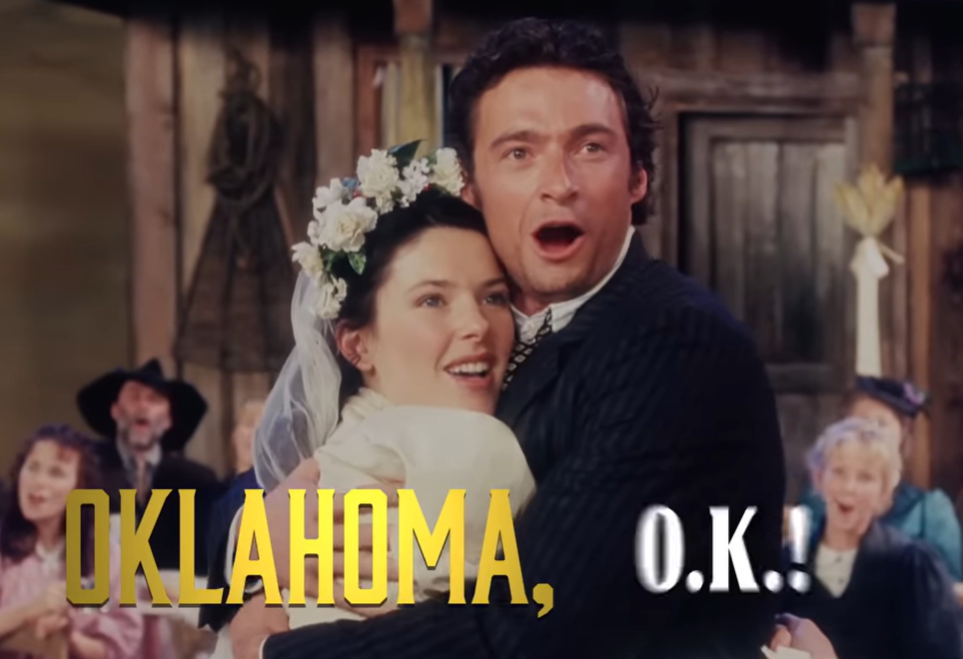
Click here and for the rest of the day, you’ll be hearing Hugh Jackman singing, and that would be OK!
(Note: I was just discussing this blog post with my husband, and I automatically said “okay” at least five times in five different usages, like “Okay” with a sigh as I got up from my chair, “Okay” to affirm that he was right about something, “Okay” to affirm that I was, well, okay…. Next time I complain about some Gen Z influencer repeating “like” and “you know” in every sentence, remind me about this… Okay?)