
Adverbing Your Verbs, or In Defense of Adverbs in Dialogue Tags
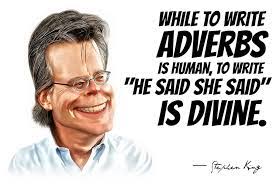
I believe the road to hell is paved with adverbs, and I will shout it from the rooftops. To put it another way, they’re like dandelions. If you have one on your lawn, it looks pretty and unique. If you fail to root it out, however, you find five the next day… fifty the day after that… and then, my brothers and sisters, your lawn is totally, completely, and profligately covered with dandelions. By then you see them for the weeds they really are, but by then it’s—GASP!!—too late.”
― Stephen King, On Writing: A Memoir of the Craft
Now I am not one to dispute Stephen King, who has sold a billion times more books than I have. And for the most part, I agree with his insistence that adverbs in “quote tags,” those little markers of who said what in a dialogue passage, should be minimized and simplified.
However, if we’re trying to replicate the experience of a conversation for the reader, we want to convey more than just what is spoken. We also might sometimes want to convey how it is spoken. In an actual conversation, there are actions and body language, both of which can be described in the narrative, and will convey something about what the speaker means. (For example, if he grips his hands into fists, that’s going to convey “anger.”)
But “tone of voice” is another way we convey meaning in a conversation– especially a meaning that is in contrast with the words being spoken. A woman might say, “Of course you’re right, dear. You’re always right.” And you’d think, oh, she thinks her husband is infallible!
Of course, the speaker probably DOESN’T think her husband is infallible. She’s probably saying that– how? SARCASTICALLY. If we were in the room and heard her tone of voice, we would hear the sarcasm in her words.
In the past, tone of voice was usually conveyed through the quote tag, the actual verb used for the action of speaking. Remember all those great synonyms for said? He intoned, or she muttered, or he hissed, or she demanded, or he commanded, or she exclaimed, or of course, the once-popular: He expostulated. Alas, a couple decades ago, many writers reacted against the undoubted overuse of those quote tags and decided the only allowable quote tag was “said”. He said. She said. Simple. Streamlined. But unfortunately, those are too straightforward to convey any nuance, any subtext, even any conflict between what is said and what is meant.
The way in prose we convey tone of voice (if we don’t get to use “expostulated!”) is through adverbs. Said + adverb. No, we don’t have to add an adverb to every piece of dialogue. Sometimes the speech line itself says all we need to know– “I don’t need any help!” for example. “Luke, I’m your father.”
But when the mere words aren’t enough to convey the meaning, let’s make use of those handy-dandy adverbs to add tone and contradiction. Here are some examples of meaningful quote tag-adverb combos, from a few of the best dialoguists:
“I wish you’d go home,” said Lethbridge wearily. (Georgette Heyer)
“Dad,” she said, as gently as she could, “I don’t need your support.” (Susan Elizabeth Phillips)
At last she said unsteadily, “It’s such a beautiful dream!” (Susan Howatch)
“Come now, John Bell,” said the bosun reproachfully. (Patrick O’Brian)
“No, no,” said Alverstoke soothingly. “No one is as stupid as Endymion.” (Georgette Heyer)
Sure, if your characters say only what they mean, and are never mistaken, and never raise their voices or ask questions, or characters who don’t always tell the truth the whole truth and nothing but the truth, you can probably get away with using only “said.” But if you’re writing characters with conflicting desires and mixed motivations, who sometimes lie or sometimes express skepticism or sarcasm, or just have eloquent and expressive voices, well, consider amplifying the “said” with a handy adverb– just when you need to, when the words they speak aren’t enough to convey all of what is really meant.
They expostulated sincerely, “I love adverbs!” 
2 thoughts on “In Defense of Adverbs (in respectful opposition to Stephen King)”
“He said through clenched teeth” is one of my favorites.
Then too, you can spot the piece written for pay by the word rags. Why use one good solid verb when you can get $.02 for each of fifteen adverbs added on. I’ve met a few Ph.D.s who are taught that their dissertations must exhaust their subject. Bring on the adverbs and exhaust them! Sadly some of them are English majors and subsequently teach their students to write like that.
I think it was Pat Wrede who said that one of the most effective uses of adverbs is to contradict the actual words.
Compare: “You complete bastard,” she said angrily.
Vs: “You complete bastard,” she said admiringly.
‘Angrily’ is superfluous, and cutting it would probably improve the prose. But ‘admiringly’ completely changes the tone and meaning of the sentence. You can’t get rid of it without ruining the effect.