
Lately I have returned to my original genre, Regency novels, which are set in the England of the early 19th Century. I hope I do justice to the time and place! It’s harder for me to imagine such an exotic setting, you see, because I’m a Hoosier.
Yep. A Hoosier. That means I live in Indiana, a place a long way from elegant, exciting Regency England. But in its own way, my Midwestern home is also intriguing, a place of certainties and contradictions.
I really didn’t mean to end up here. My parents, in fact, were both born here in Indiana, and when they met at Purdue University, they agreed on two things: They wanted many children, and they wanted to get the heck out of the Midwest. So they raised their many children (eight of us) in the Blue Ridges of Virginia. I grew up surrounded by siblings… and mountains.
You can probably figure out what drew me back to the flatlands my parents fled. Of course, it had to be a man. He was (and remains) a dazzling man, which is fortunate, because I found our new Midwestern home less than exciting. I was used to waking up every day to the sun rising over the mountains, but here the sun rises earlier because there’s nothing but horizon out there. Where I would expect to see forests were cornfields. And instead of roaring waterfalls, I saw only lazy rivers.
But I stayed. (What can I say? Love reigns.) And four decades later, I haven’t just made my peace with the Midwest. I’ve discovered the specialness of this ignored region. This nation of ours—there is no region without beauty and mystery, not even the flat “flyover country” everyone ignores. The Midwest has its own beauty, not the big dramatic panorama of hills and valleys, but a vista that goes on for many miles with subtle variations in land and water. It is more than the breadbasket of the nation, the place of stockyards and soybean fields. It’s the place of rivers and riverbends.
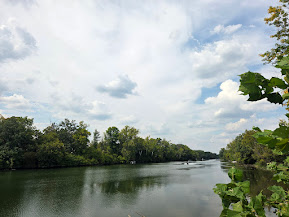
What I thought I would lament the most, the flat terrain, turns out to be the creator of the most significant aspect of this place. When the land is mostly level, the water (and there’s a lot of water—the Great Lakes, remember!) finds the cracks and fissures and starts winding down in its leisurely but relentless way through the woods and meadows. The Midwest draws its uniqueness from its many rivers, which carve their winding paths through field and dale, from the Great Lakes to the Great Rivers of Ohio, Mississippi, and Missouri.
A river is an enigma, never the same from day to day. When the summer is hot and dry, the water level is low, and old logs and rocks and sandbanks appear—only to vanish with the next rainstorm. You can never predict where a river will bend and how it will move. There’s something enchanting about hiking to a riverbank and looking ahead and see the water curving into the trees and disappearing around the bend. The stream is often hidden by the droop of trees along the banks.
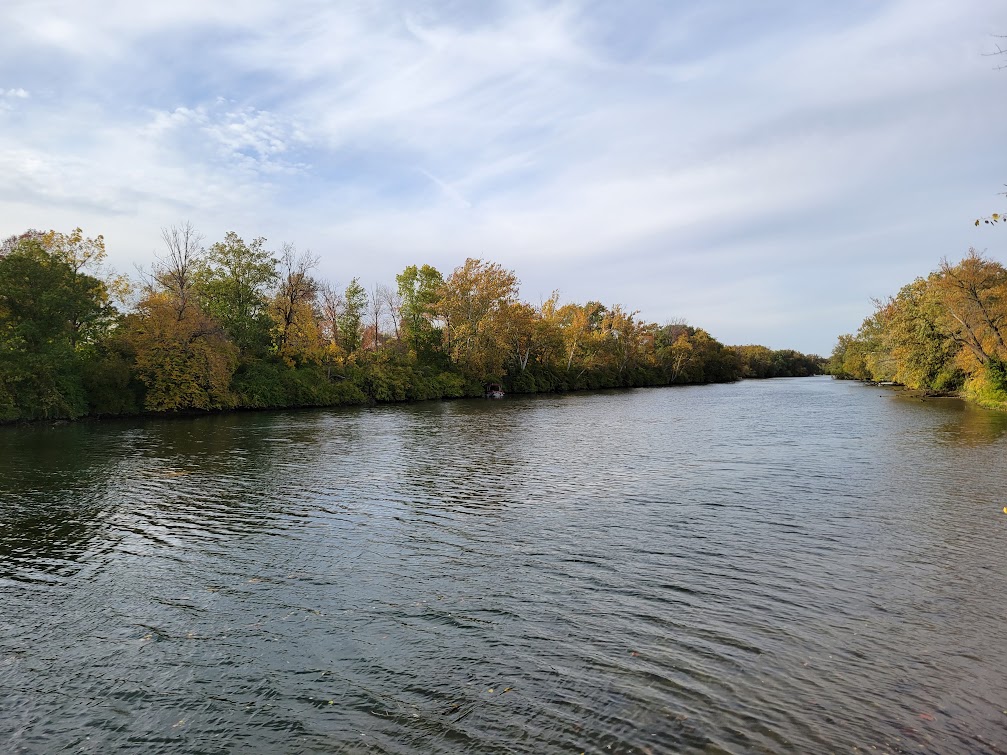
Most of the forests in the Midwest were mowed down to make farmland, but along the rivers, the water-loving trees—the willows, the sycamores—grown tall and strong and flexible, spilling their reflections in the summer and their leaves in the fall. And in the pale winter light, they carve stark and grim angles over the water, “bare ruined choirs,” as Shakespeare put it, “where once the sweet birds sang.”
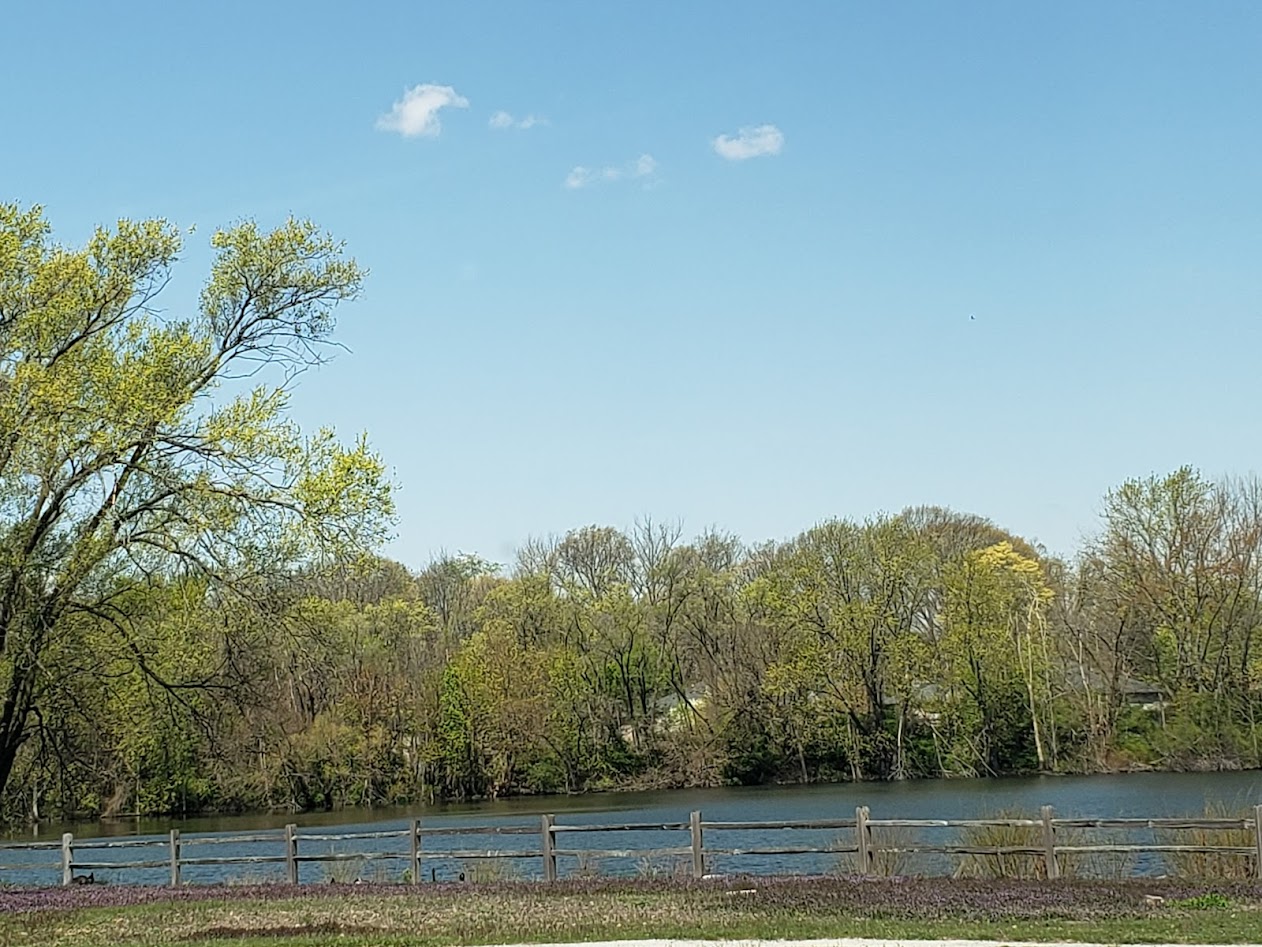
Now we live on one of Indiana’s main rivers, the White, and every day as I write, I look out at that ever-changing ribbon of silver. It moves slowly but inexorably, reflecting the sunlight that filters through the trees. No, it’s not the White Cliffs of Dover or my childhood mountains, but there’s plenty of inspiration in the winding way of water in the flatlands.
What about you?? Where do you live, and what’s its secret beauty? What landscape inspires you?
3 thoughts on “River Deep – Mountain High: American Inspiration”
Having lived in cities most of my life–on both coasts– I have settled in the foothills of an 11,000 + foot mountain. A semi rural neighborhood with lots of tall and taller trees, creeks and streams leading to 3 rivers that merge into one, and recently all three have been classified as wild from source to sea without a single dam left in place. Salmon spawn there. Deer feast on our flowers, and bears menace our birdfeeders for whatever the squirrels don’t get. We have periodic infestations of raccoons and an occasional mountain lion. Coyotes sing whenever a siren erupts on the highway–which becomes more frequent because the nearest city has drawn law enforcement away from us to deal with drug crimes and inflatable frogs protesting the ICE building. Speed limits aren’t even suggestions anymore. So we listen to the wildlife sing in response to sirens and relish the fresh air.
I do envy you the long horizon. Sunrise and sunset up here are about 45 minutes behind or ahead of the valley because of the ridges.
Yes, we do have long sunsets! The midwest sky is the real big sky, nothing but trees in front of a horizon.
Do you get any flooding? Three rivers meeting sounds like quite a flood plain!
We actually are right in the middle of a city, but we have coyotes and deer and foxes occasionally. There’s a big park just south of us, and the critters are in the woods there and along the riverbank. We used to have beavers even, but I haven’t seen any sign of them for years.
No bears!
Alicia, we’ve had occasional flooding when an ice dam higher up breaks and releases pent up water and a pineapple express brings half the Pacific Ocean inland. But these are little rivers, nothing like the big ones that water half the continent, They don’t get big until the Sandy River hits the Columbia River 35 miles away. But our little Zig Zag river has a stretch that runs UPHILL, where the snowmelt hits a basalt ridge so fast it goes up and over rather than around. Big Foot hangs out around there.