
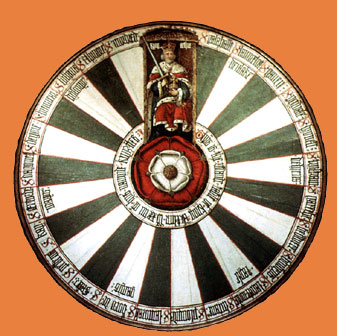
Way back in 2012 six specfic writers, including me, decided to set up a monthly circulating blog series: one unifying topic, fantasy, and one post each per month, on each member’s site in turn. Eventually it was named, partly in jest, “The Great Traveling Round Table Fantasy Blog,” and it lasted for most of three rounds.
My own posts are the only ones I can now retrieve, but some of them still strike me as interesting, if somewhat out-of-date. I’m therefore aiming to re-post them here for those who may be interested. I’ve also included the image that became our leit motif: The Arthurian Round Table, from a picture in Winchester, UK.
And the 11th topic was/is:
The Abilities of Disability – at Least in Fantasy
In real life, “disability” is exactly what it says. A lack. A limitation. A loss of possibilities open to others, whether to see, to hear, to walk, to run, or just to go a week without the black dog of depression dropping on your back to take the taste out of everything.
Atop the inner physical limitations, come external ones: doors too narrow for a wheelchair, handles too high to reach, prompts or safety signals only visible, or only audible. A flight of “simple” stairs. Even an escalator can be another infuriating check to someone with a “disability.”
Add on the invisible limits: as with race, class, and colour, even heterosexuality, disability can leave a person either Othered or literally invisible. Even when visible, the unlucky Other has to run the gauntlet, if not of naming for the problem – right up or down to names like Hopalong Cassidy – then of the other egregious reactions, from pity to repulsion: less happily than Hopalong, the person vanishes behind the stereotype.
In fantasy, as with race, class and colour etc., things could, even ought to be different. Alas, a quick mental survey of Fantasy I Have Read matches too well with the real-world social map: blind seers or crippled beggars appear quite often among minor or even lesser characters. I can recall only one high-to-mid-level blind character, the bard in Tanya Huff’s Four Quarters series, who is definitely and encouragingly NOT disabled by his blindness and indeed, in the first book, plays a crucial climactic role.
Again, in The Privilege of the Sword, the second book in her Riverside series, Ellen Kushner offers a powerful cameo of her previous lead character, the great swordsman Richard St. Vier, now suffering from loss of all but peripheral vision, yet devising his own remedies, to remain a swordmaster unparalleled.
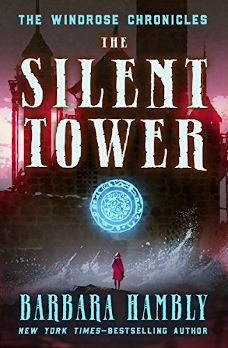
Barbara Hambly has two main male characters, wizards, whose magic is off-set by poor vision. One is Antryg Windrose, from the Windrose series, from the first book, The Silent Tower, her most notable wizard, and perhaps my favourite among wizards, Gandalf included. Antryg’s myopia is definitely not “disabling” – though his ability to practice martial arts without his glasses does stretch my credibility – it is only one in a bouquet of anti-establishment attributes. Antryg comes from a dirt-poor tundra family, he learnt his arts from the series’ main villain, and he is more gloriously dotty than even T. H. White’s Merlin, even Antryg frequently considering himself to be outright mad.
There is no deaf, blind, and certainly no paraplegic or quadriplegic main character or protagonist in any fantasy I can think of (and don’t mention Bujold’s Miles Vorkosigan, his universe is unequivocally SF.) Does this mean mainstream fantasy is as exclusive of the disabled as of non-WASP, middleclass, heterosexual protagonists?
There is some justification, on narrative grounds. Fantasy is, after all, an adventure genre. Protagonists have to be equally fit for flight or fight, accustomed or at least able to confront dragons and scale castles at a blink. As Hambly’s Californian geek computer programmer ponders at one point in the Windrose series, after three days spent on the run, or the walk, in a pre-Industrial countryside, eating bread and cheese and sleeping in haystacks: “Thank God I don’t have allergies – that’s probably something selected against in the evolution of heroines”(Silent Tower.) And so are blindness, deafness, and of course, any form of wheelchair limitation. Disabilities just make things too difficult for the writer, you see?
But should they? Try telling anyone that Long John Silver’s wooden leg limited Treasure Island in any way, adventures included. Come to that, does lameness limit Hopalong Cassidy? Sure, it would probably bring an appreciable change if Long John had needed to push a wheelchair over Hispaniola, but otherwise?
In fact, for a writer, disability should present not a limit but a valuable asset, especially in building characters. And by this I don’t mean simply turning the “disabled” to an Other of terror and nightmare, as Long John Silver becomes. Without going completely Pollyanna, I consider disability in a main character will give a writer not just means to individualize him/her, but to strengthen that character morally, emotionally, and what matters most to a writer, charismatically.
I can say this from experience: in the third Amberlight book, Source, I invented an imperial heir, known as a crown prince, with a “delicate stomach,” that could be upset without warning or rule by certain foods. (Art again anticipating nature, I later found one of my own friends actually has this problem.) At the time, this was just an individuating quirk in a mid-range character. But Therkon went on to become the male lead in the fourth book, Dragonfly, and there I was charmed to find his stomach upsets did not merely show Men under Pressure Behaving Well, but could actually function as part of the plot. Not merely to hamper the action at crisis but to advance the emotional plot (love-story, okay?) and, in one case, to help hero and heroine out of a tight corner as well.
Again, though I can’t recall a fantasy hero with a mental disability, (there are a few in SF), I managed to produce one who could suffer from clinical depression. Unpublished as yet, The Heart of the Fire was meant as my version of the super swordsman: silent, deadly, impregnable to all finer feelings. Unfortunately, by Chapter 2 his workname had become The Killer Caramel, since he had developed an incurable weakness for fostering orphan calves.
Later, more lethal character flaws surfaced: at life crises he would drink himself, not into mere alcoholism, but to a hair-trigger readiness to take offense, and in his case, kill someone. Or someones. Later, he would sink into life-threatening lethargy. Only after four books and buckets of wonderfully dramatic angst did his life even out to a point where these phases finally faded away.
Such “cures” are less available in reality. But as a writer, I have found disability, at least of a “minor” variety, a powerful and fertile trope. Ironically, at least to a writer, “disability” should be considered less a limitation than a valued basis on which to build a strong, dramatic, even charismatic hero/ine. And what writer would consider one of those a disability?
************************************
Sylvia Kelso lives in North Queensland, Australia. She writes fantasy and SF set in analogue or alternate Australian settings. She has published twelve fantasy novels, two of which were finalists for best fantasy novel of the year in the Australian Aurealis genre fiction awards, and some short stories in Australian and US anthologies. Some of her books can be found in the Bookview Cafe online store: