
The Traveling Round Table Fantasy Blog(s) – 2
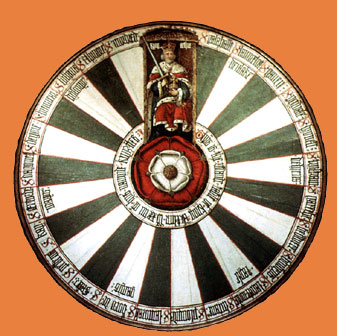
Way back in 2012 six specfic writers, including me, decided to set up a monthly circulating blog series: one unifying topic, fantasy, and one post each per month, on each member’s site in turn. Eventually it was named, partly in jest, “The Great Traveling Round Table Fantasy Blog.”
My own posts are the only ones I can now retrieve, but some of them still strike me as interesting, if somewhat out-of-date. I’m therefore aiming to re-post them here for those who may be interested. I’ve also included the image that became our leit motif: The Arthurian Round Table, from a picture in Winchester, UK. The second blog topic was:
Language in Fantasy.
Time was, everything appearing on the SF and Fantasy bookshop shelf (ah, those pre-Kindle days!) could have been assessed against Ursula Le Guin’s ukases in her famous 1973 essay, “From Elfland to Poughkeepsie.” Forex: “Many readers, many critics and most editors speak of style as if it were an ingredient of a book, like the sugar in a cake … The style, of course is the book…”
And: “Why is style of such fundamental significance in a fantasy?… In fantasy there is … no borrowed reality of history, or current events… There is no comfortable matrix of the commonplace to substitute for the imagination, to provide ready-made emotional response… There is only a construct built in a void, where every joint and seam and nail is exposed…”
As exemplar, Le Guin did a masterly hatchet job on one unfortunate fantasy writer of the early ‘70s whose language could not move from the Poughkeepsie of a contemporary political or spy story to the rarefied air of Elfland.
Le Guin charted a number of the traps, now listed all over the Web, that await young players attempting such Elsewhereness. Archaisms the writer can’t handle, especially the old second and third person singular verbs – “I go, thou goest, he goeth,” forex (I had just found a then-current blog purporting to speak for Chaucer and using third singular for an imperative.) Then, exotic but evanescent oaths and ditto gods. Also the Dreaded X-Y-Z-apostrophe invented-word: Xard’ril the Warrior (Princess?). Yarrin the Village. Zal’ope the God of Small Things. (Many others are pilloried in Diana Wynne Jones’ Tough Guide to (High) Fantasyland.)
(At this point, please note, I am now using Elfland as a metonym for Elsewhere – elves are optional, but a successful fantasy must still transcend Here.)
Le Guin did cite two master stylists whose passports to Elfland were secure: Tolkien and E. R. Edison. The latter, I have seen dismissed recently for “too elaborate language,” and the other is probably going the same way, but everything Le Guin found in them is still true. The fantasy she wrote about does demand language from Elsewhere, it goes best with a real stylist, and, as Le Guin also wrote, “A fantasy is a journey. It is a journey into the subconscious mind, just as psychoanalysis is. Like psychoanalysis, it can be dangerous; and it will change you.”
Except, nowadays, most of what’s sold as fantasy isn’t high fantasy.
So, does it need a master stylist to reach Elfland if you aren’t producing a secondary world, a “construct in a void” totally reliant on your language skills? Can you even see Elfland from the streets of a contemporary urban fantasy, even one as sharp as Katharine Kerr’s License to Ensorcell series? Or have Stephanie Meyer and Peter Jackson’s hairdressers overloaded the genre with tall pale handsome men who either glitter or carry FAR too much hair?
And if you can’t see Elfland, is the language to blame?
It’s certainly easier for the less-skilled writer to handle characters with “realist” names and venues he or she may walk through daily. But it’s also harder. Because how do you invest these places and people with “the air of Numenor?” How do you get Elfland to happen, right here?
It can be done. Peter Beagle’s The Folk of the Air transformed parts of San Francisco with no more than some SCA players, a goddess, a witch, and some time travel; but Peter Beagle, like Tolkien, is a stylist par excellence. I have to admit that it (still) doesn’t happen for me in most current urban fantasies, where the Otherworld element either has really dorky names, or appears so mundane I feel I’m in The Gated Hell Community or Vampire Suburbia. These are Elvenlords. These are vampires. They are not the Guyz Next Door. They are danger, REAL danger, they carry the scent of Elsewhere. They should raise your neck hair, not your fashion sense.
So, yes, language in fantasy does still matter. For this reader there is no substitute for a word-smith, whether in modern San Francisco or beyond a helpful wardrobe. The old traps still pertain, and so do the old demands. By the end, as Le Guin stipulated, a “real” fantasy novel, high or contemporary, will have to deal successfully with archetypes. And hence it will need to be, “a journey into the subconscious mind, just as psychoanalysis is.” And ‘’[l]ike psychoanalysis, … it will change you.”
I don’t know that huge numbers of the contemporary and now cozy fantasy and paranormal romance market will reach that last criterion. It will be the language that does it, if they do.
*************************
Sylvia Kelso lives in North Queensland, Australia. She writes fantasy and SF set in analogue or alternate Australian settings. She has published twelve fantasy novels, two of which were finalists for best fantasy novel of the year in the Australian Aurealis genre fiction awards, and some short stories in Australian and US anthologies. Some of her works appear in the Bookview Cafe store under:
https://bookviewcafe.com/bvc_author/sylvia-kelso/
1 thought on “The Traveling Round Table Fantasy Blog(s) – 2”
Matt Ruff, The Fool on the Hill, is akin to the Peter Beagle.