
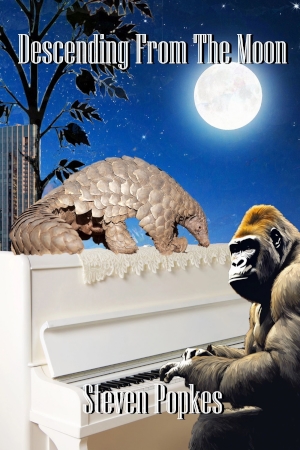
 Descending from the Moon
Brother to Jackals, Book 1
by Steven Popkes
LeRoy Parkin had a secret: a project to raise the intelligence of chimpanzees, gorillas, orangutans, and baboons to human levels.
Some would say that wasn’t a very high bar. Fifteen years after he began, plagues – preventable but not prevented – broke the world, killing over 99% of the world’s human population. Parkin survived, moving his team and the animals to a secure island for the duration of what would become known as the Die-Back.
Fifty years later, the Die-Back ended with the Restoration of the United States. The remaining humans nervously focused on recovery, trying to keep at bay old fears and prejudices long discarded in favor of survival. Parkin, now an aging patriarch, left the apes on the island and restarted LifeWorks on the mainland.
After two decades, they have had some success.
But three years ago, the apes began discussing who they were, what they wanted, and what they should do next.
Today, they’ve made the decision.
In this first volume of a post-apocalyptic science fiction trilogy, author Steven Popkes reminds us of the connections that both sustain and endanger humanity and the world around us.
Brother to Jackals, Book 1
____
Steven Popkes lives in Massachusetts on two acres where he and his wife raise bananas, persimmons, and turtles.
He works in aerospace making sure rockets continue to go where they are pointed. He insists he is not a rocket scientist.
He is a rocket engineer.
Buy Descending from the Moon at the Book View Café bookstore
Read a Sample
Prologue
“Animals are not brethren, they are not underlings. They are other nations, caught with ourselves in the net of life and time.”
—Henry Beston
Mister Coyotee
Excerpt from the Mr. Coyotee Show, subscribed service:
Disclaimer
Mister Coyotee is an animated system interviewing representations of actual human people. Resemblances to individuals, living or dead, are not coincidental at all. Resemblance of Mister Coyotee to an actual coyote, real or mythical, is marginal at best. The guests of the show may or may not be simulated, in whole or in part, at our discretion.
M.Coyotee
We’re going to be serious tonight in honor of the twentieth anniversary of the Restoration of the United States. While this is not a recognized holiday, it is an opportunity for a moment of reflection.
My two guests tonight are Doctor Willa Rogers, historian from Columbia University in New York, and Doctor Michael Brandt, historian from Harvard University in Cambridge.
My question to my guests seems a simple one: it has been twenty years since the Restoration. It has been close to seventy years since the beginning of the Die-Back. Where are we today?
W.Rogers
I’m not sure that’s where we should begin. After all, Mike and I can’t even agree when the Die-Back began and when it ended.
M.Brandt
Oh, please.
W.Rogers
I’m serious. Did the Die-Back begin with the first plagues, fifty years or so before the Restoration? Did it start with the Year of the Tsunamis—forever known as YOTT?
(Both laugh.)
Did it begin ten years after the first plagues with the disbanding of Congress and the Chu abdication?
M.Brandt
Clearly, the Die-Back had to begin when people actually died.
W.Rogers
The Year of the Tsunamis killed millions of people.
M. Brandt
Yes, it did. And I am not going to disparage the pain and suffering it caused. But out of eight billion people, the tsunamis didn’t kill a measurable fraction. The real Die-Back—when the plagues started taking ten or twenty percent of the population per year—didn’t begin until five years later.
W.Rogers
Agreed. But the rebuilding physical and social movement that began with the tsunamis was the environment in which the plagues began.
M.Brandt
So what? The plagues began in a social structure. What a surprise!
W.Rogers
You don’t think that had an effect?
M.Brandt
I do not. I think the effect of wiping out the vast majority of humanity in barely a generation swamped any influence from the contemporaneous social structures. Therefore, I start the Die-Back fifty years before the Restoration.
W.Rogers
That’s where we differ. I think not only did the social reforms influence how the Die-Back proceeded but had an effect on the Restoration.
M.Brandt
You’re talking about the Big Five Amendments: 34: National Referendum. 35 and 36, the two voting reform amendments. 37, likeness and privacy. 38, nationalized disaster response. I think you can make a case for nationalized disaster response having an effect on the Die-Back itself but not for the other four. They do affect the Restoration, of course. But tracing a line from the beginning of the Die-Back to now isn’t justified. Saying the amendments had an effect then and have an effect now, therefore they must have had an effect between then and now is just wishful thinking.
W.Rogers
You don’t think the Chu abdication had any effect on the Die-Back?
M.Brandt
Only as an indication that all of the efforts to stop the Die-Back—including nationalized disaster relief—had failed.
M.Coyotee
You can’t agree on when the Die-Back began. You also said you didn’t agree when the Die-Back ended.
W.Rogers
The plagues died down fifteen years or so before the Restoration. Was that the end of the Die-Back? But those fifteen years were hard enough without having people dying of plagues. They were dying from things like starvation and lack of medical care.
M. Brandt
I think here Willa and I are closer to agreement. I do hold to a strict historical interpretation of the Die-Back timeframe: it began when the plagues began and it ended when the plagues fell back to pre-Die-Back levels. But that doesn’t mean I’m blind to those years between the Die-Back and the Restoration. People were still dying from the knock-on effects of the Die-Back—
W.Rogers
Dying from lack of government, mostly.
M. Brandt
Dying from lack of supplies, I think.
Words matter. Some historians have said that the two great wars of the twentieth century—World War I and World War II—should be considered the same war. That neglects the twenty-one years between them. Twenty-one years that included a great depression, technological advancements, and huge political changes.
This is true here. A strict interpretation of when something began and ended is necessary to understand properly what came before and what came after.
W.Rogers
I disagree. I think that we are impressing boundaries and labels on things that were not so boundaried and labeled at the time. The Die-Back starting point might be apparent to my worthy colleague from Harvard but it wasn’t so clear to those living at the time. To them, it was a wave of disasters the scale of which would not be clear for decades. That said, they had already lived through a significant disaster just a few years before. That disaster drove their response to this disaster.
M.Coyotee
And we’re back to arguing the beginning instead of the end.
W.Rogers
These things matter.
M.Brandt
Of course, they matter. But they matter mostly to you and me. These are academic discussions.
W.Rogers
Academia was lost until after the Restoration. Harvard reopened fifteen years ago. Columbia reopened ten years ago.
M.Brandt
These things don’t much matter to the people now, twenty years after the end of the Die-Back.
W.Rogers
Has the Die-Back even actually ended?
As Mike said, those who lived through the last seventy years are not monolithic. Some lived through the entire span of it regardless of where we place that date. They suffered excruciating trauma. Some were born in the latter days of the Die-Back leading into the Restoration. The world they were born into had already been destroyed. They saw that destruction as normal. The Restoration was a relief. Some have been born since the Restoration was declared. They live in increasingly better times.
But all of them—and us—live in the shadow of the Die-Back.
I don’t think the Die-Back is done with us yet.
M.Coyotee
Let’s table this discussion and say for argument’s sake that the Die-Back began seventy years ago and came to an end with the Restoration, twenty years ago.
This is a presidential election year—the fifth since the Restoration and the first one with an incumbent seeking reelection. It’s also the first such election where the full complement of voters born in the year of the Restoration are eligible to vote.
So: on this anniversary, where are we?
M.Brandt
Traumatized.
W.Rogers
Hopeful.
M.Coyotee
Explain. Willa?
W.Rogers
All of the legal and social changes before the disbanding of Congress are still in place, plus some new ones that came just before and after the Restoration. The remaining one percent—
M.Brandt
Or less.
W.Rogers
—of the population is trying to make sense of things. They’ve moved towards cities—
M.Brandt
Because of the Accords.
W.Rogers
Because of the robot industrial base that has been made accessible to them because of the Accords.
M.Brandt
Which nobody likes.
W.Rogers
It’s hard to like mechanisms that were shooting citizens to protect rotting crops. The Accords changed that.
M.Brandt
But if there are robots and a robot industrial base, why are we so limited? We have magnificent trains. Why don’t we have airplanes?
W.Rogers
Exactly. We have an autonomous, industrial base supplying goods at essentially no cost. Why can’t we create—overnight—the same culture we had before the Die-Back happened?
M.Brandt
Is that so unreasonable a question?
W.Rogers
So far, the robots have been rebuilding housing, reconstructing water, sewage, power, and network infrastructure, and supplying food. So, in this time frame, yes: it’s an unreasonable question.
M.Brandt
My point isn’t that the prospect of getting everything for Christmas may or may not be reasonable. My point is that the question, itself, should come as no surprise. People want airplanes. They get biotech—of which they are just as suspicious. Most consider the Die-Back an example of biological warfare.
W.Rogers
Not state-supported warfare. More like biological terrorism by uncounted non-state groups.
M.Brandt
That makes no difference to them.
W.Rogers
So, you’re saying that not trusting the robots and not trusting the biotech—both of which are making the Restoration even possible—is natural?
M.Brandt
Exactly.
W.Rogers
That’s irrational.
M.Brandt
That’s human.
M.Coyotee
I think we understand why Dr. Brandt said “traumatized.” But we didn’t hear why Dr. Rogers said “hopeful.”
W.Rogers
Each year since the Restoration we’ve had to contend with one crisis or another just to achieve normal operation. Now we have reliable water. Reliable power. The last Shuman election was uneventful—no one blowing up polling stations. No network worms consuming votes. Just casting votes and counting them—comfortable normalcy. Hence, hopeful.
M.Brandt
I disagree with my worthy colleague. I agree we’ve been distracted by crises for the last twenty years and those have largely been addressed. We have normal business. We have normal leisure. But we also have new concerns. New religions. New issues poking up their heads. We still have our repressed traumas and fears to be faced—as Willa pointed out, we have half the population considering the Die-Back as a morality play and the other suffering from PTSD because of it. It’s a seethe of free-floating anxiety from a thousand sources. Eventually, it’s going to crystallize around something.
W.Rogers
What?
M.Brandt
I have no idea.
M.Coyotee
Nor do we. But when we do, you know we will talk about it here. Wherever you are, viewers, good evening or good morning, and from Mister Coyotee, good night.
Three Years Before
‹ Marcus ›
The solarium had an indoor pool, but few of the apes did more than occasionally wade in the water. The pool lay, blue and inviting, in the center of the vast, enclosed concrete span. Only a young chimp and an orang played in the shallow end.
Around the pool, there were dozens of apes enjoying a warm winter afternoon nap. Most of them were gorillas and orangs, with a scattering of chimps.
Marcus Joan Marcus, an old silver-backed gorilla, slept in a favored spot on the top of the thirty-meter board. Normally, the orangs occupied this spot, but today he had luckily found it empty and claimed it. Marcus had a melanin dysfunction causing a white splotch on his left shoulder. It itched continually. Marcus scratched in his sleep.
Now, he dreamed.
He kept trying to dream easily, peacefully of a lake, glinting in the sunlight, the mountains purple behind the water. But his manmind wouldn’t leave him alone. It kept populating the image with boats, birds, a man fishing, the sound of the wind. In his sleep, Marcus kept blinking the clutter away. It kept coming back. He brushed his hand against his face, waving it away in irritation, and the contact woke him. He scratched his shoulder.
Above him, sitting on the railing, a young orang watched him. For a moment, Marcus kept seeing lake and canoers and he couldn’t figure out what this young orang was doing here. Then, he came fully awake and sat up. He looked outside the solarium and saw the light snow on the ground, the white buildings, the beach, and beyond the whitecapped marbled shallows, a towering reef of trees, shielding them all from the cold Atlantic Ocean farther away.
“Are you awake, Marcus?” said the orang. “Did you dream?”
“Nothing of consequence.” Marcus rubbed his face. Then, Marcus realized that given the young orang’s lesser status, he would not be here without a mission. He stared at him balefully. “Pontiac, how long have you been waiting for me to wake up?” he said irritably. The damned orangs were so formal—if something was going on, why the hell didn’t Pontiac just nudge him?
“About an hour, I think. Maxwell sent me.”
Marcus stretched his back and stood up. It hurt to stand up straight but Marcus managed it as often as he could. The other apes respected you more when you stood like a human. “What about?”
“He sent me to fetch you. To come to the chimp building. It’s about Pearl. He said specifically to tell you it was about Pearl.”
“Pearl?” Marcus looked down at Pontiac witheringly. “And you waited an hour? May you be culled.”
Buy Descending from the Moon at the Book View Café bookstore