
Louis Trevelyan, Domestic Tyrant
Trollope understood that men can be the victims of masculine power and violence too. There’s Phineas Finn, for example, who is shot by his best friend (Lord Chiltern) in a ridiculous duel, and then shot at by Robert Kennedy. Both of the attackers believed that the inexplicably charming Phineas was “stealing” their property, that is, the women they thought they owned.
To stretch an analogy, slavery in the United States of course most greatly harmed the people who lost their freedom and lives to the absolute power of the overlords. But the south’s insistence on letting rich people own other people led to the Civil War and hundreds of thousands of men’s deaths. It also led to the south being held back for another century by the refusal of its lawmakers to accept the innate dignity and liberty of others. And, well, to get all spiritual, as its greatest writer William Faulkner made clear, slavery became the original sin that corroded the soul of everyone in the region.
While marriage isn’t slavery, it becomes almost as evil when one of the couple claims ownership of the other. In Victorian times, of course, the law supported that claim. Women could be beaten, raped, institutionalized. Their husbands could steal all their money and abduct their children. And the courts wouldn’t intervene, unless, of course, the wife’s father or brother was more powerful than the husband. (Then maybe there would be some justice.)
The First Cracks in the Wall
Trollope was writing in the time when women’s right to the property they brought into the marriage was a Parliamentary issue. There were two essential changes to the laws that limited (at least for rich people) the absolute power of the husband. The Divorce Act of 1857 gave some separated and divorced women certain property rights, mostly to what they brought into the marriage. While men could divorce their wives by alleging adultery, women still more limited grounds to divorce their husbands—“Adultery +”—a man had to have committed adultery and another malfeasance to be divorced. Lathan and Landow (2018) explain, “For the first time, women could file for divorce, but the wife needed a reason in addition to adultery, such as incest, rape, bigamy, cruelty or desertion, whereas the husband needed merely to prove his wife’s infidelity — a remnant of the original procedure for obtaining a divorce. The court could rescind a decree if any evidence of collusion between husband and wife came to light. Custody of any children, whether by the husband or not, was awarded to the husband under the Custody of Infants Act (1839).” So even if a woman could secure a divorce and her own fortune, she always risked losing her children forever. This was a major plot point in He Knew He Was Right, the paternal ownership of children.
The Married Women’s Property Act of 1870 gave wives limited control over their possessions and earnings. Before that— there was a reason women writers like Jane Austen didn’t marry or delayed marriage. Anthony Trollope would have observed how his mother—a relatively successful writer in her middle and late age—had no legal right to her own earnings. And women rich in their own right (like Madame Max in the Palliser books, and Miss Dunstable in the Barchester stories) often held off on marrying until they were mature enough to choose good husbands (and good solicitors to negotiate the marriage settlements).
There are few divorces in Trollope’s stories (which is true to life—divorce was very rare even after the 1857 act). But he certainly described several marriages that should have resulted in a divorce, including the three “bad husband” marriages I am discussing in this blog series. Laura Kennedy definitely would have preferred divorce to being forced to flee the country to escape her violent husband. And Emily Trevelyan’s situation, in He Knew He Was Right, could hardly have been worse than divorce even in those inequitable times. Her husband hounded her, emotionally abused her, constantly accused her, and eventually stole her child away. Worst of all, he descended into madness and slow suicide, which was torture to her because she did love him.
He Knew He Was Right (But He Was Wrong)
An orphan with an inheritance, Louis sought no political power, but his wealth gave him the freedom to travel and later to marry as he liked. His Grand Tour of the world took him to an obscure corner of the British Empire, the mythical Mandarin Islands. The governor there, Sir Marmaduke Rowley, was one of those English gentlemen who would have failed in London, so had to be packed off to rule the colonies. As always, Trollope was quite precise about finances: “He had been governor of many islands, and had never lacked employment; and now, at the age of fifty, found himself at the Mandarins, with a salary of £3,000 a year, living in a temperature at which 80° in the shade is considered to be cool, with eight daughters, and not a shilling saved.”
When Louis arrived—a handsome fellow who disclaimed any need for a dowry from a bride—he was immediately designated as the perfect husband for the oldest of the eight daughters. Fortunately, Emily liked Louis (“a remarkably handsome young man, who was well connected, who had been ninth wrangler at Cambridge, who had already published a volume of poems, and who possessed £3,000 a year of his own, arising from various perfectly secure investments”), and they were soon off back in London and married. He even offered to support Nora, one of Emily’s many sisters, until she found her own husband. Trollope hinted at a potential issue: As Lady Rowley was the first to find out, he liked to have his own way. “But his way is such a good way,” said Sir Marmaduke. “He will be such a good guide for the girls!”
“But Emily likes her way too,” said Lady Rowley.
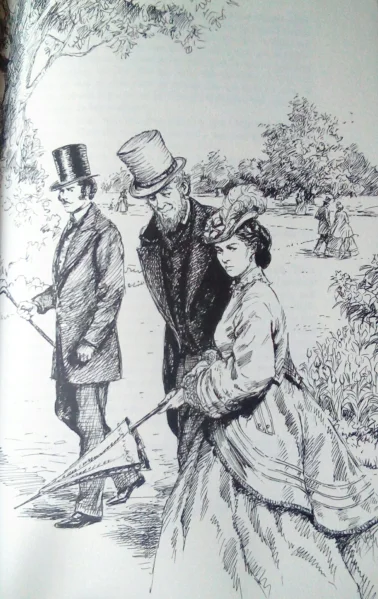 This conflict erupted after two years of wedded bliss produced a baby boy. Emily confessed to her sister that Louis now suspected her of flirting with Colonel Osborne, an old family friend—older than her father, but far more charming—who came to visit a few times. Emily reacted to this suspicion as a vile accusation, and the battle was joined. She viewed this as an attack on her honor, but also an assertion of ownership, bitterly terming him her “master” and herself as “an upper servant”. Her sister sensibly suggested that she should refuse to let the colonel visit, but Emily dismissed that as a restriction on her right to choose her friends. She did admit that if Louis would ask her directly to deny Osborne, she would do it as he would be acknowledging that she had a choice. But instead he preferred to cast aspersions, to suspect her, to accuse her, and to demand her confession.
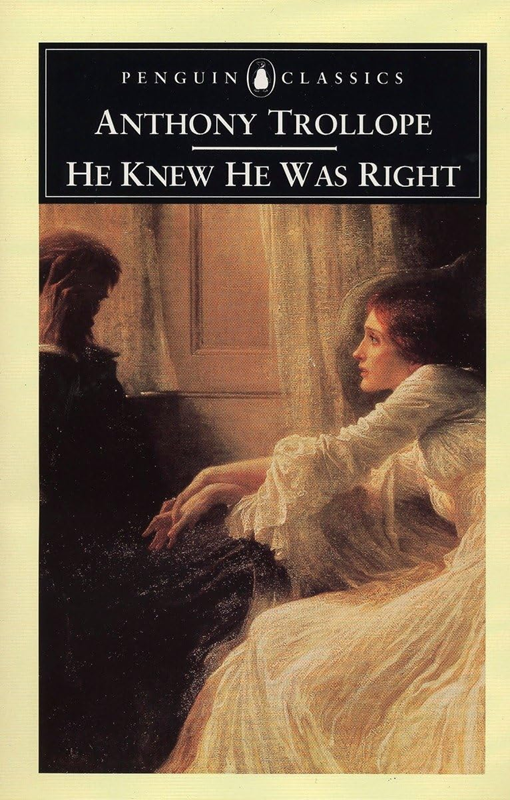
This is a subtle distinction, because what he chose to do did not give her a choice. No matter what, his mind was fixed that she had in some way betrayed him. “He Knew He Was Right” is the title, and that’s a clear statement of the problem. He was wrong, but he—the man, the patriarch, the arbiter of truth—“knew he was right.” And his being right (even or especially if he was wrong) was more important to him than his wife’s honor and their happiness.
And that was the insoluble issue. She could not resolve this by agreeing to turn the colonel away. That wasn’t even what Louis wanted anymore. What he insisted on was that she confess that she had been disloyal, and she refused to admit that because she didn’t believe it.
Then his accusations became ever more extreme. Eventually he became convinced that she had actually been unfaithful, and rather than divorcing her, he harangued her. For months. Eventually he exiled her from his house, though he agreed to continue to support her financially. Why? Because she would not confess to being “a disgraced woman.”
“You Don’t Own Me!”
As I was researching this book, I was surprised to find that some women commentators not just disliked Emily (which is fair—she’s pretty annoying), but thought she was plain wrong to keep seeing the colonel. (Trollope predicted just this gender-betraying reaction: “Like all women, she thought that when a man was to be separated from his wife, the woman must be in the wrong.”)
I think they might have misinterpreted what Louis was furious about. Emily did indeed reject the visits of the colonel, but that wasn’t enough for her husband. Louis wanted her to confess to something she hadn’t done. She hadn’t been unfaithful, and refused to lie and say she had. She could not dishonor herself, even if it meant that he would resume the marriage.
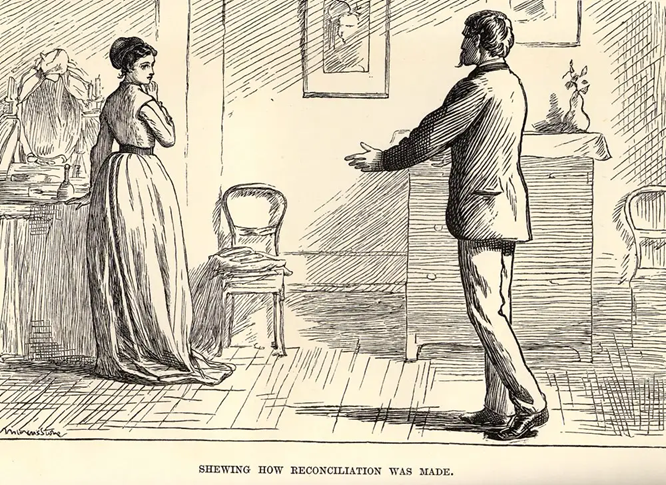 Trevelyan’s friends urged him to go to her and take her back, but he could not. “Trevelyan thought that if he went to Nuncombe Putney, his wife might perhaps jump into his arms; but what would come after that? How would he stand then in reference to his authority? Would she own that she had been wrong? Would she promise to behave better in future? He did not believe that she was yet sufficiently broken in spirit to make any such promise. And he told himself again and again that it would be absurd in him to allow her to return to him without such subjection, after all that he had gone through in defence of his marital rights.”
Notice what he asserted there—his authority, his rightness, his right to break her spirit and demand subjection.
Now I have to admit that when I read that passage, I started singing that early feminist anthem that still resounds today: Lesley Gore – You Don’t Own Me.
Okay, so back in the prison of patriarchy, it just got worse. Louis couldn’t break his wife’s spirit, but he realized he could break her heart. He hired an ex-policeman to kidnap their son. Again, he had the legal right to custody of the child, but he took him because he knew it would destroy his wife. He also knew that by this point, he wasn’t really able to take good care of a child. But when Emily’s mother begged to know if they could see the boy, Louis made it clear that he demanded absolute submission:
“Ah;–that is just what I am not prepared to tell any one who has taken my wife’s side till I know that my wife has consented to pay to me that obedience which I, as her husband, have a right to demand. If Emily will do as I request of her, as I command her,”–as Trevelyan said this, he spoke in a tone which was intended to give the highest possible idea of his own authority and dignity,–“then she may see her child without delay.”
“What is it you request of my daughter?”
“Obedience;–simply that. Submission to my will, which is surely a wife’s duty. Let her beg my pardon for what has occurred.”
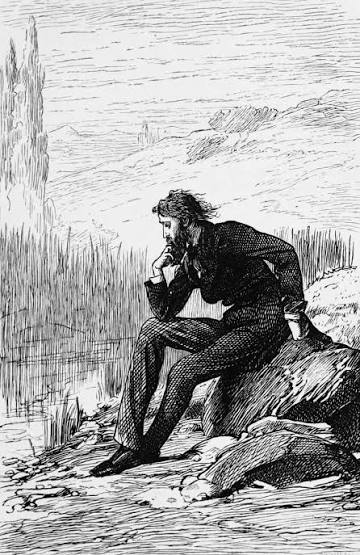
This insistence, meant to bring Emily to heel, instead condemned him to a bitter isolation. To punish her, he took the child to Italy, refusing to let her even know the location. But then he realized the little boy feared him and his intense anger, and some last vestige of sanity told him that he could not keep him any longer. When Emily finally was allowed to take the child, she was horrified at Louis’s condition. He was very sick, and starving himself. Though she had once had the intention of taking the child immediately, she found she could not leave her husband behind. She took him back to England and nursed him through his long final illness. At the end, she begged him to believe that she had not been unfaithful.
It is a horrific heartrending scene as he subsided into death, still unforgiving. Trollope was unsparing. But he gave Emily one bit of hope. “But at length the lips moved, and with struggling ear she could hear the sound of the tongue within, and the verdict of the dying man had been given in her favour. He never spoke a word more either to annul it or to enforce it.” She chose to believe this tiny sound was an affirmation.
But Trollope left this ambiguous, presenting the possibility that Trevelyan disregarded his wife’s ultimate show of loyalty, chose his own “rightness” over her love, and died still hardened in his toxic assertion of authority.
Like Robert Kennedy, Louis Trevelyan killed himself slowly because he could not give up his need for power over a woman. I was so troubled by this final moment that I had to force myself to reread it to write this post. I’m not sure anywhere in literature there is any more intense indictment of the cancerous nature of patriarchal authority. They both regarded these spirited, intelligent women, and saw only perversion of what they believed was the “natural order”.
One more bad husband, and one more suicide—this one deliberate. Then we can go on to happier subjects of women, their familial relationships, and their friendships.