
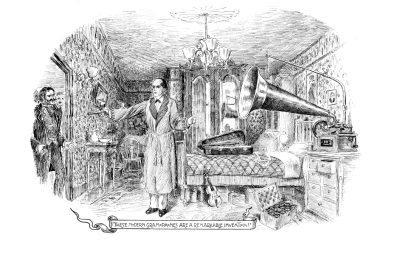
Recording Pictures and Sound
Two other technological innovations Holmes encountered were photography and audio recording.
By Holmes’s time, cameras and film had evolved enough that photographs could be taken surreptitiously. In “The Adventure of the Six Napoleons,” Inspector Lestrade found one of these photos in the pocket of a dead man, and Watson referred to it as “a snapshot”:
It was evidently taken by a snap-shot from a small camera. It represented an alert, sharp-featured simian man with thick eyebrows, and a very peculiar projection of the lower part of the face like the muzzle of a baboon.
In “The Adventure of the Second Stain,” a newspaper account (presumably leaked by Sherlock) explained another photographic clue: A comparison of photographs has proved conclusively that M. Henri Fournaye and Eduardo Lucas were really one and the same person, and that the deceased had for some reason lived a double life in London and Paris.
Just as quickly as Holmes could use photographs to solve cases, criminals could use them to commit crimes. The most clever of these villains was the only woman ever to fascinate Holmes, the opera singer and blackmailer Irene Adler. She had incriminating evidence on the client, the Bohemian king. At first, Holmes was skeptical.
“Then I fail to follow your Majesty. If this young person should produce her letters for blackmailing or other purposes, how is she to prove their authenticity?”
“There is the writing.”
“Pooh, pooh! Forgery.”
“My private note-paper.”
“Stolen.”
“My own seal.”
“Imitated.”
“My photograph.”
“Bought.”
“We were both in the photograph.”
“Oh, dear! That is very bad! Your Majesty has indeed committed an indiscretion.”
There’s a certain irony in Holmes’s acceptance of a photograph as proof of authenticity. Later, in 1917, his author (Conan Doyle, I mean, not Dr. Watson) would be famously fooled by two girls. They cleverly used the technique of photographing photographs to create evidence of fairies in an English garden. Conan Doyle staked (and damaged) his reputation for perspicacity by swearing these photos were real, not faked. See for yourself:
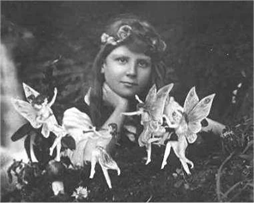
The Fairy Photograph
The Gramophone
Holmes was an excellent musician, and played the violin for his own entertainment and to calm his overworked mind. He took time off from cases to go to a concert, often dragging a reluctant Watson along.
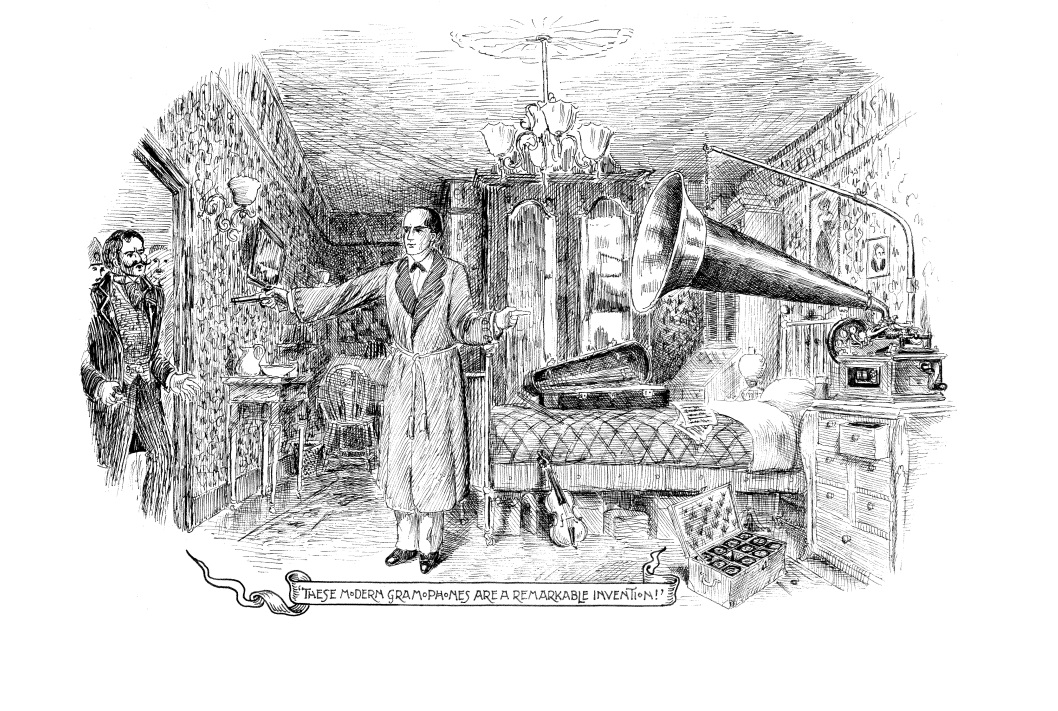
So it’s hardly surprising that he would be an early adopter of the “gramophone”, collecting rare recordings of professional musicians. And naturally he found an investigative use for this new invention. In “The Adventure of the Mazarin Stone,” Holmes left two suspects alone and retired to the next room to play his violin. The two suspects heard him playing his violin, and assuming they were alone, discussed their crime. In fact, he’d crept back into the room and hid behind the curtain to learn their secret. The violin music was a recording. When the police arrived to arrest them, one of the suspects exclaims, “But, I say, what about that bloomin’ fiddle! I hear it yet.”
“Tut, tut!” Holmes answered. “You are perfectly right. Let it play! These modern gramophones are a remarkable invention.”
(Music historian Oliver Mundy insists that in fact, Holmes must have been using a phonograph, of the sort invented by Edison, because that allowed recordings of more than a few moments. The explanation is too complicated to summarize, but you can read his monograph here, and he includes a great picture of Holmes with whatever record player he possessed.)
In a time of great technological innovation, Holmes made use of these new inventions to investigate his cases. But in the next blog post, I’ll discuss Holmes’s use of what we used to call “a killer app”—a perpetually useful invention that has yet to be replaced—the printing press.
More about Holmes as an early adopter in the Simanaitas blog.
Alicia Rasley