
Fire and Rain
FIRE AND RAIN
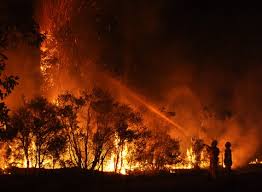
When my husband and I moved to the foothills of Mt. Hood, Oregon thirty years ago, the local Fire Marshall told a community meeting that we should call the area “The Asbestos Forest.” There was so much moisture embedded in every cell of our local douglas firs and western red cedars, that they might lose a few fringe branches in a wildfire, but the trees would not burn.
Ten years before that I worked with some of the rangers at the Fort Vancouver National Historic Site. The youngest and fittest of them kept their wildfire fighting credentials current for the extra pay. They laughed that living in the Pacific NortWET, they’d never get called up.
Then Yellowstone National Park burned, and my coworkers got called up. When they got back home more than six weeks later, every last one of them refused to renew their fire fighting credentials. You could see the glaze over their eyes that hinted at PTSD. One whispered “If it hadn’t burned this year, we’d have had to burn it next year.”
Decades of suppressing wildfires allowed insect and disease infestation.
So now the policy is to allow fires to burn themselves out and only suppress them when they endanger homes.
That policy doesn’t take into account the devastation of climate change. Now every summer massive wildfires dominate the news. Here in our little corner of woodland paradise we face week long power outages during summer heat waves as the electric company shuts down the grid to avoid stray sparks and overheated wires spreading fires wider and wider. They claim many lives and homes are saved by these shut downs when outdoor temperatures break new records of heat and desert dryness.
Last year the island of Maui burned. More paradise lost to wildfire and climate change.
Fire is a natural part of the cycle of a forest’s life, or so scientists tell us.
We see these fires on the news time after time.
Jump back to 1939 in western Oregon. August, a full summer of unprecedented heat and drought. A spark from a timber operation in the Coast Range of mountains set fire to an entire county. It had happened before, but for the first time people had radio communications and aeroplanes to report the fire to the news stations. Ships 500 miles out to sea reported a pall of ash covering the skies. Chicago had ashfall too when the wind shifted.
Oregon beaches were buried two feet deep in ash and debris.
The population of the west coast had never seen anything like that.
No one had experience in fighting wildfires, they had to let it burn until autumn rains came.
When the flames finally wore themselves out, 240,000 acres had burned. Thirteen billion board feet of lumber were consumed. No one knew how much wildlife died.
County and state governments started asking “how can we handle this in the future?”
A program to build access roads into virgin wilderness began. Tanker trucks with pumps to pull water from creeks and nearby rivers were designed and built.
Six years later 1939, the Tillamook Burn erupted in flame again. This time the fire burned not as many acres. Volunteers helped contain it. Some.
More access roads, better pumps, more tanker trucks, and trained volunteers tackled the overwhelming task of fighting a wildfire.
Six years after that 1945 a third fire erupted. Recently discharged veterans from World War II were drafted to add their numbers to the firefighters. Quite a homecoming after victory against the Nazis.
By 1951 when a fourth fire broke out, professional fire fighters with modern, up to date equipment, and helicopters carrying water and fire retardant were available.
The fire barely registered on the new televisions and newscasts.
That winter reseeding began. My brother remembered a Boy Scout field trip carrying a backpack filled with douglas fir seedlings. Church groups and schools added more children, teaching them about wildfires. Smokey the Bear began telling all of us “Only you can prevent forest fires.”
I can remember in the late 1960s traveling from Portland to the coast driving through miles and miles of vibrant new trees with bare spikes of dead trees rising above them, lonely sentinels of disasters not so long ago.
This was also a time when traveling through the natural wonder of our forests in summer, every driver was required to keep a shovel in their trunk, and men between 15 and 50 could be forcibly requited to fight fires in the area of their travel.
Professionals now handle the job with safety equipment and training. We close campgrounds and roads. The power companies have the authority to turn off electricity to an entire county if deemed necessary for health and safety.
Late spring of 2024 on a recent drive through the Tillamook Burn, most of the overt signs of previous fires are covered with new growth. But there are road signs chronicling the events. We learned a lot from those fires and now we have plans and evacuation routes. We cope with power outages and wear masks when the smoke is so thick we can’t see across the street.
Wildfires are now a way of life. Climate change creates new fires every year that are bigger and more devastating.
We’ve learned a lot since the Tillamook Burns of 1933, 1939, 1945, and 1951.
Some people still don’t believe that climate change exists, let alone is a problem.
2 thoughts on “Fire and Rain”
I did not see this yesterday when it went up. Somewhat ironic timing. Last night I asked my daughter for ideas about what I should blog about this coming Sunday. One of her suggestions was that I blog about the wildfires I and my family have been through. In 2020, my extended-family’s cabin was destroyed in the so-called Creek Fire. A few weeks after that, my immediate family and I had to evacuate from our home due to the so-called Glass Fire. The structure made it through that one, but the fire came so close it burned other parts of our condo complex. I found I was unwilling to write a blog entry about the topic. Too much PTSD. Too much emotion.
Good thoughts and healing Dave. We have an evacuation plan. The last 2 times we’ve had the fire saftey power outages we ran away. Problem is that places with power, internet and running water tend to be subject to the smoke infestation as home.
We are all hoping for a milder fire season this year. Wishing all in the pathways good luck and lots of rain to keep it all in check.