
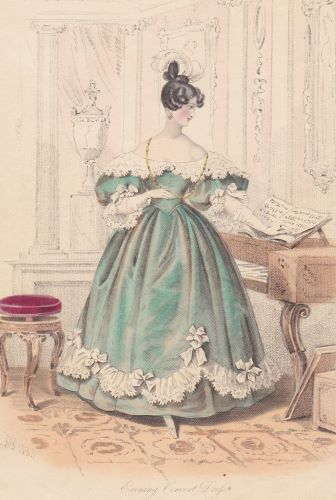
 You may know that I collect early nineteenth century ladies’ magazines, because I adore the fashion plates. Here’s one of my favorites, an 1835 Evening Dress from Court Magazine in a vibrant green fabric. Charming, yes…and, as it happens, extremely dangerous.
The dye that created that lovely fabric–and similar green tints in things from shoe leather to wallpaper—was created from arsenic. Before the early nineteenth century, there was no color-fast green dye; in order to get anything vaguely green, fabric had to be dyed yellow, then overdyed with blue…which though popular (readers of Regency fiction will recognize this if I call it by its name of the time—Pomona green), generally didn’t hold up very well.
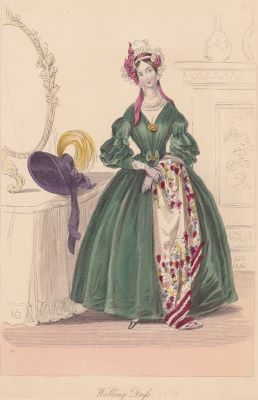 Then a German chemist created the first colorfast green dye using copper and arsenic; known as Scheele’s Green, it was a hit, though it did tend to blacken in the presence of sulphur compounds. A later refinement in 1814 led to the creation of Paris Green, also known as Emerald Green—and green became an immensely fashionable color, as we’ve seen on some of the prints I’ve posted. Everyone wanted green dresses, green shoes, artificial greenery to wear in headpieces and millinery. They also wanted Emerald Green décor, so upholstery and drapery fabrics, green carpets, and most of all wallpaper became The Thing right through the 1870s. Even Napoleon in exile on St. Helena had green wallpaper in his house…which may have contributed to his death.
Everyone loved the new, rich green dye, but didn’t entirely understand its toxicity. When the recipe was first published in the early 1820s, a few far-seeing physicians cautioned against its use. Dye manufacturers tried tinkering with the ingredients to mitigate and conceal the deadly nature of Emerald Green…and eventually resorted to the simple expedient of changing its name.
By the 1870s, synthetic green dyes began to be developed and the demand for Emerald Green decreased, but not before thousands died from wearing green clothes, living in green rooms, and eating confections dyed with Emerald Green…not to mention the workers who made those clothes or otherwise came in contact with it. Talk about fashion victims!
1 thought on “Death and Dyeing”
Books clad in Paris Green book cloth were also a huge hit . Starting in the late 1820s mass-produced books covered in cloth–a cheaper alternative to leather–became popular, and as publishers wanted the books to stand out on the shelf, they experimented with a lot of techniques–foil stamping, printing directly on the cloth–including the color of the cloth. The Poison Book Project at the University of Delaware is a fabulous resource–and can generally help you determine whether that copy of The Woman in White is hazardous to your health.