
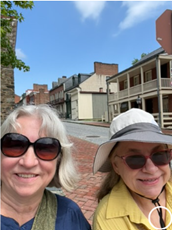
The final stop on our sisters’ trip was Harpers Ferry, up in the eastern corner of WVa, where the Potomac and Shenandoah rivers meet. It’s also a tri-state moment: West Virginia in the point of the triangle, Maryland just across the Potomac, and Virginia just across the Shenandoah. We travelled through all three states in about ten minutes!
I’m really preoccupied with the 19th Century this year. It’s 1826 in the Regency mystery series I’m writing, and Jeff and I are visiting many 150-year old places in our survey of Indiana small towns. And I just finished an immersion into the novels of Trollope and the stories of Conan Doyle. So Harpers Ferry—founded in the 18th Century but mostly built in the 19th, felt familiar. The major themes of that century in America—race, civil war, industrialization, frontier—are all stamped into the landscape in this tiny (262 pop) town.
The 18th Century is still apparent in the town. Two early presidents—Washington and Jefferson—visited the town. Jefferson stood up on a promontory on a rock that now bears his name and proclaimed this “perhaps one of the most stupendous scenes in nature.” Washington surveyed the area for one of his early canal projects.
But it’s in the 19th Century little Harpers Ferry became important as a stop on the journey west into the frontier. The two rivers allowed easy transport to the west and south, and then the railroad came through linking Baltimore and Washington, DC, to the new cities along the Ohio River. Industrialization started with the grist mills powered by the river, and iron and brickworks used in the bridges, railroad, and houses in the town.
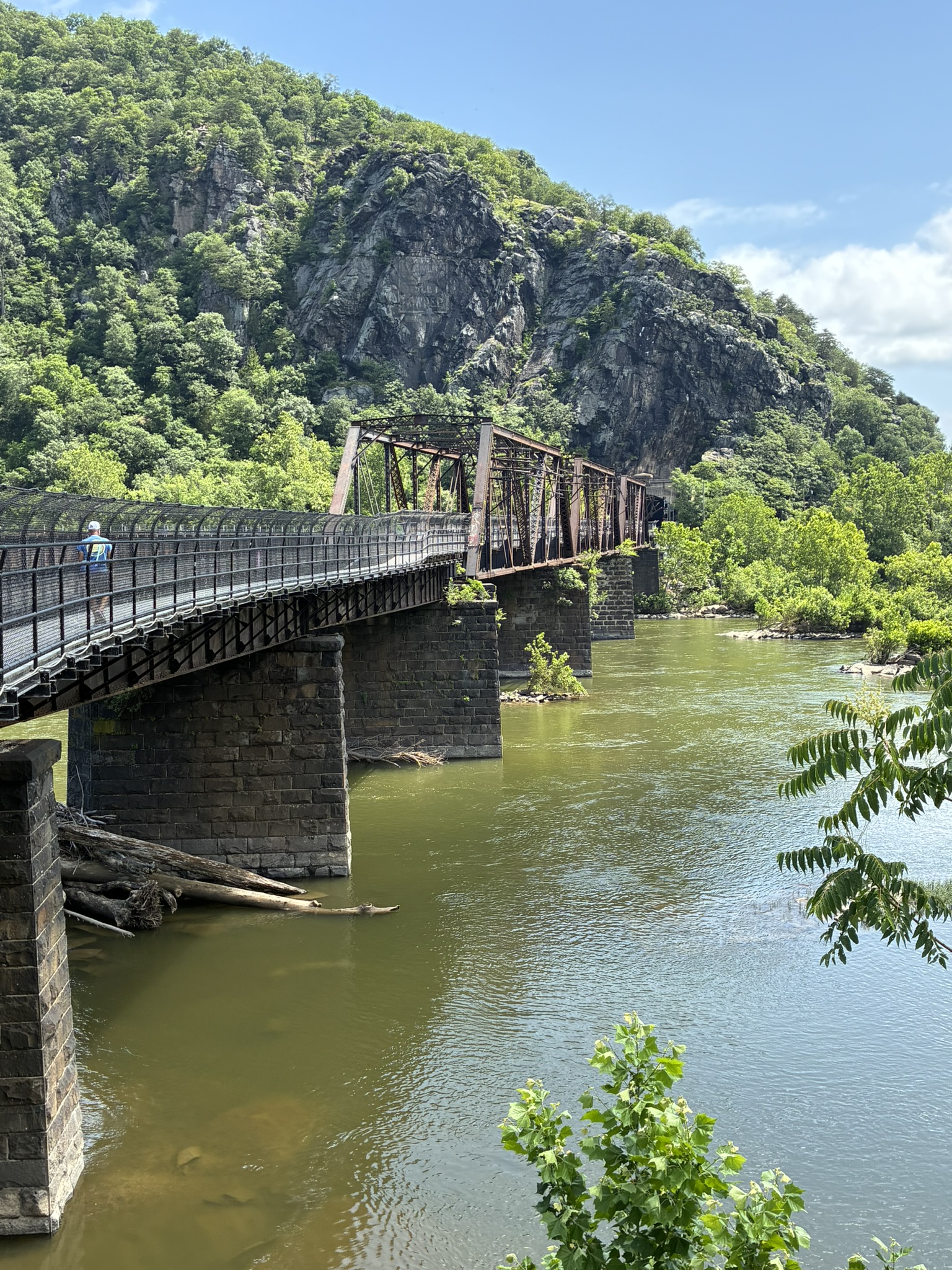
Most significant was the town’s place in history. This was where abolitionist John Brown in 1859 led a group of 22 men on the town armory, hoping to confiscate weapons to use in a rebellion against slave owners. The rebellion failed, and John Brown and other insurrectionists were quickly executed. However, this action was one of the sparks for the secession of southern states and the consequent Civil War. Stephen Vincent Benet memorialized John Brown’s contribution in the epic poem John Brown’s Body:
I hear the rolling of the wheels,
The chariots of war!
I hear the breaking of the seals
And the opening of the door!
West Virginia (previously part of Virginia) seceded from Virginia in 1861 and became a Union state. Due to its significant location on the two rivers and railroad, it was the site of at least five battles during the war, and the town was badly damaged and depopulated.
Post-War
But after the war, the town became a center of education for the newly emancipated population. Storer College opened in 1867 as a “normal college” to train black men and women as teachers. Frederick Douglass served on its board of trustees, and the college also hosted a meeting of Niagara Movement of W.E.B. Du Bois, which led to the founding of the NAACP. Graduates went on to teach in “free schools” throughout West Virginia, and the school produced a number of “firsts”—the first African-American attorney in the state, the first black state librarian, and even the first president of Nigeria.
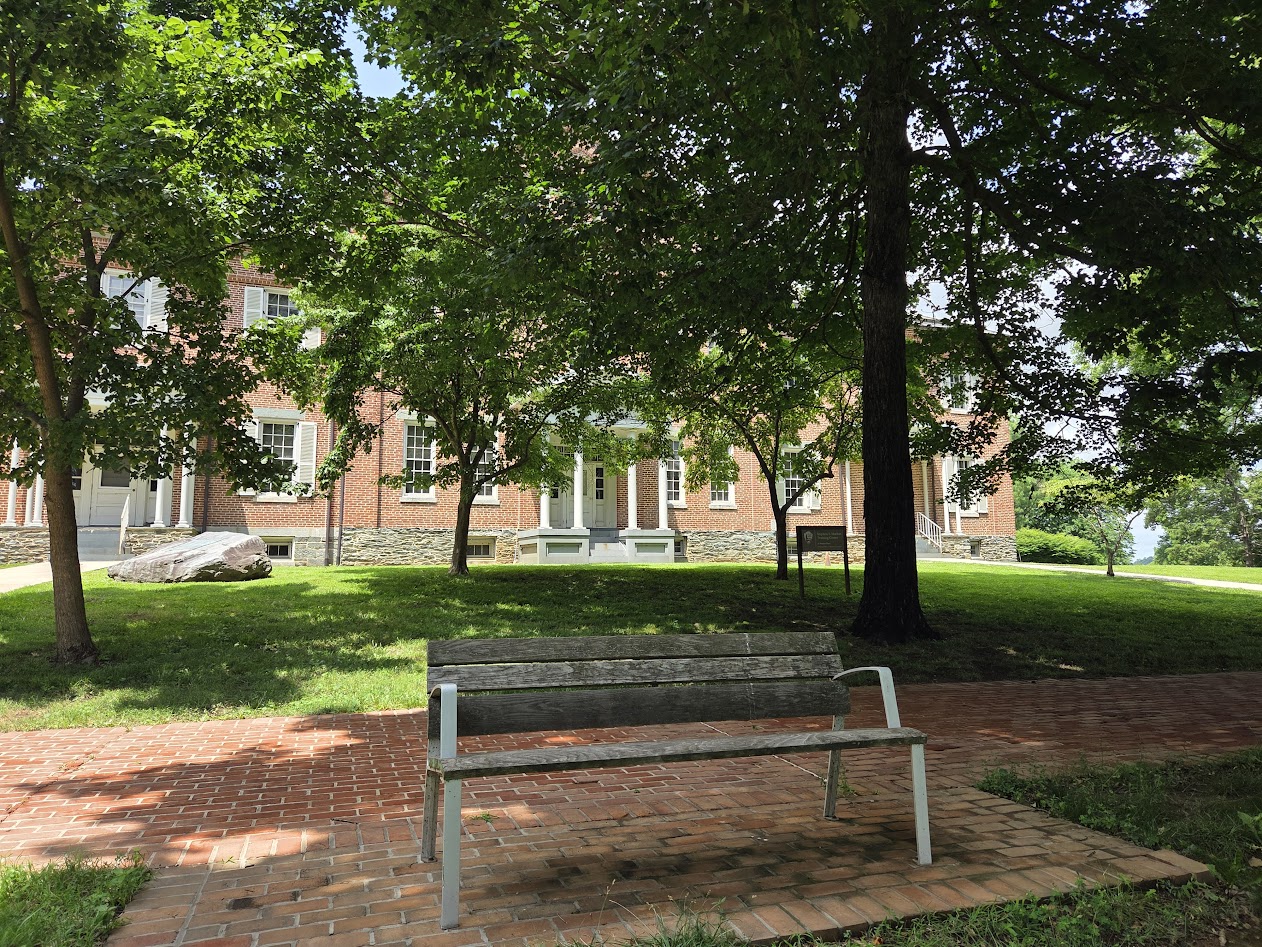
One graduate, Thomas Lovett, stayed in town and built the huge Hill-Top Hotel on the top of the hill overlooking the two rivers. I gave a workshop there decades ago. It’s now being renovated after 150 years.
Jo and I stayed in a beautiful Queen Anne house just up a steep hill from the pretty town center. We felt very strong after we hiked down for dinner, at least until we saw the other visitors. The Appalachian Trail runs right through Harpers Ferry, so the town was full of sunburned and super-fit hikers stopping to refuel and recuperate.
The town is now an actual national park, with historic museums, great hiking, and stunning vistas. Check it out if you’re in the DC area. It’s just an hour and a half by train from Union Station, a beautiful trip through the mountains and along the Potomac and ending at a depot in front of a row of colorful 19th Century “highrises”.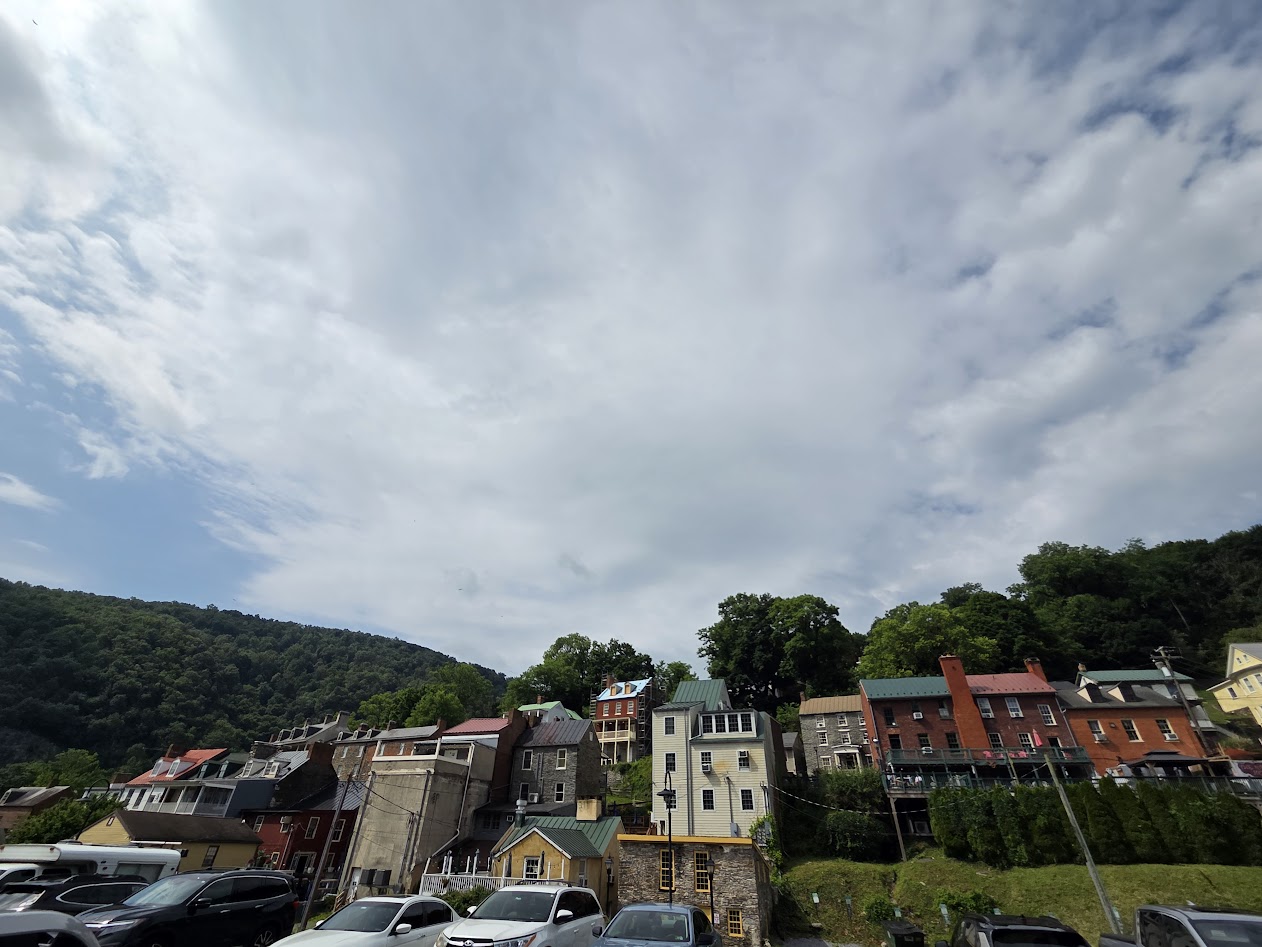
4 thoughts on “Harpers Ferry– A Historical Hotspot”
Thank you for these brief opportunities to dip my toes into the land of my middle school years. We lived in the Virginia Beach area from 6th-10th grades. Schooling was deeply shaped by a southern interpretation of the War Between the States and segregation was a huge part of life. For many of the non-military families the war had never ended. I sincerely hope that society has progressed since then.
Yes, I remember they called it “the War of Northern Invasion.” Or “The Second War of Independence.” I’d lived in Boston the year before we moved to Blacksburg, and took 7th Grade American history there. 8th Grade in Virginia, it was like there was a whole different American history, one where the north started the war because they were jealous of the south’s “independence”.
What was intriguing in my own little town of Blacksburg, the state college there, Virginia Tech, was founded by none other than Abraham Lincoln. Sort of. It’s a “land grant” college, where the federal government gave land and funds to the state to build the school. That was in 1861, just before the war started.
In Maryland and Virginia, History–or their version of history–was the lifeblood of the school system. No other subject was important. Science and math could wait for college, if you were so inclined. But the RIGHT version of history would sustain you in any career.
Phyllis, in high school, we had TWO YEARS of Virginia history. One year of US history, one year of world history. The implication was clear– Virginia had the most history!