
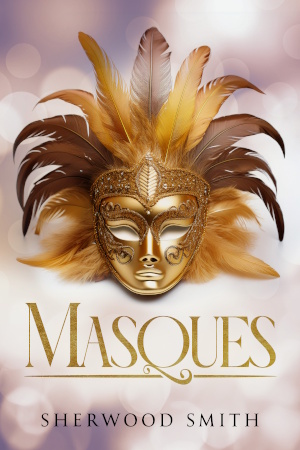
Masques
by Sherwood Smith
“Disguise your passion in masque; when the dance ends, peril begins.”
It’s nearly fourteen years since the Norsunder War ended. But peacetime still has surprises for The Trouble With Kings’ second gen, especially those with high ambitions.
Sky Szinzar, Princess of Ralanor Veleth, has loyally insisted on the betrothal she made to Lexan Glenereth, a landless boy with no prospects, made when they were kids. Her peers utterly scorn a “betrothal” she formed at age twelve—a scorn led by sarcastic Prince Garian-Rafael.
Now it’s fourteen years later, and Sky is finally holding her coming-of-age ball, which is spectacularly ruined by her abduction. On horseback. Right off the ballroom floor . . . by the prince she hates most. A wager or a lark?
When courtship between him and her and him (or is that him and him and her?) wears the guise of high politics, the dance soon gets wild.
This cozy romantic fantasy comedy of manners stands alone.
____
Sherwood Smith writes fantasy and SF.
1
“You ought to know by now that nothing is perfect, my darling.”
Flian, widowed queen of Ralanor Veleth, tenderly regarded her beloved but sometimes exasperating daughter. Her smile was quick, and a little rueful; if there had been any sting in her soft, mild voice, that smile and the loving gaze above it would have entirely banished it. “And when it comes to things like balls, perfect is not always fun.”
“This ball will be perfect and fun,” insisted Liara Viana—nicknamed Bright-Eyes and Eyes-of-Sky-Blue by her father, echoed by her fond Uncle Jaim during the war, and shortened to Sky by her teens.
Then, thinking she sounded a little too much like her cousin Aledra, she added, “You know that ordinarily I don’t care about things being perfect. But I only come of age once. So, I thought, why not make it perfect? For everybody. I want it to be the sort of memory that will always make everybody smile. Not just me.”
“It’s your celebration, sweeting,” Flian said after a little pause. “Of course it ought to be just as you like. And I hope it will be as perfect as you want.”
“So, did you remember to order a new gown?”
“But I will not be attending your coming of age ball,” Flian said with a smile.
“What? Why not?” Sky seemed genuinely upset.
The idea that her daughter wanted her there brought a sting to Flian’s eyes. Many youth preferred to entertain one another. Which was the way of things! The new generation ready to burst on the world, displacing their boring, old-fashioned elders.
“Because your guests will have far more fun if there isn’t a widowed queen demanding solemnity just by her presence. No, no, don’t protest. You know it’s true. Your friends, especially those not familiar with me, would use their most formal manners—their elders’ exhortations echoing in their ears. We older generation will enjoy a grand entertainment at Midwinter Festival. How’s that?”
Sky eyed her mother. “That’s a promise?”
“Agreed.” Flian chuckled. “You drive a hard bargain.”
There was a quiet knock.
Sky knew that knock. That meant Chief Markham—Home Guard Chief Markham Glenereth—was here for the commencement of royal affairs.
“Enter,” Flian called, as she did every day. This was the way things had been when Sky’s father was alive. The mornings’ affairs always began in this room, sometimes called the south room for its south-facing windows, because it had been her father’s favorite room in the entire fortress. And after the war ended her mother and Chief Markham kept up with the tradition.
Mother and daughter smiled in welcome, though Sky’s faded when she saw the sheaf of paper on the tray he carried. “Those from the scribe desk?”
He dipped his head slightly in assent, silver-touched dark hair swinging forward. He was very tall, and broad through chest and shoulders, a solid and comforting form. Another comfort was how little he’d changed, except for that silver at his temples. He always dressed in the green of the home guard, of which he was commander.
“Would you like some coffee?” Flian asked. “It’s freshly ground and brewed. And Berry saw to it that my favorite rolls were brought in.”
As always, he politely declined; this, too, was like those childhood days; he was scrupulous about the distinctions of rank.
Flian glanced at the papers, then turned her smile on her daughter. “Here’s work related to your Papa’s last project. Do you want to stay and hear about it?”
The context, Sky suspected, was her being officially of age. Which meant dealing with the tedium of state affairs. She glanced at the top page, and saw the word ‘merino.’
Sheep-farming had indeed been her father’s last project for bolstering Ralanor Veleth’s economy before the war. The soil of the southern Velethi plains was too poor for farming, and too hot and dry in summer, but the wild horses had known for centuries that the same tough fescue and wild clover that apparently loved that rocky environment during winter rains was ideal for fodder.
“I’m leading the winter in-gather,” Sky reminded her mother unnecessarily. She knew it was a cowardly defense, but she did so hate numbers, especially tallies, and anyway she had her ball to plan. “I ought to get back to my list of tasks. I’m supposed to meet with Steward Berry to take a look at the ballroom. It’ll surely need sweeping out, and Uncle Maxl’s chandeliers taken down, cleaned, and polished.”
The three magnificent crystal chandeliers had replaced torch holders in the great hall, now the ballroom. These chandeliers, a decoration rare in Ralanor Veleth, had been a wedding gift for Sky’s mother from Uncle Maxl, King of Lygiera on the other side of the Drath mountains. The castle staff tended to refer to them as “King Maxl’s crystals,” and the family as “Uncle Maxl’s chandeliers.”
Sky was gone in a flash of cloud-blue eyes and rippling dark hair.
Flian smothered a sigh, and turned to the papers, which she and Markham went through with practiced speed. The ones requiring Flian to answer in her capacity as queen, she set aside, then, tidying them with absent fingers, she said, “About Sky’s ball.”
Markham gave a slight nod. “I’ve already arranged the guard rota to accommodate that.”
“Thank you. I was sure that would be the case. But I was just thinking: few, if any, of those rowdy noble boys come to dance.”
Markham’s lips twitched in what might be regarded as a smile—an expression no one but her saw. “They come to flirt.”
“Yes. But if some of that flirting extends to looking for, oh, challenges once the mulled wine has been replenished a few times . . .”
Markham said, “We’re prepared for, ah, spontaneous competitions between dances.”
Flian sat back in relief. “I don’t think she invited Garian’s boy, which I have to confess relieves me a bit. I don’t dislike him. Not really. And I don’t hold Rafael’s father’s misdeeds against him. It’s just that if Rafael was invited, I’m afraid he might instigate another squabble with Sky, or run some prank, and ruin this ball she has worked so hard to make perfect.”
Markham knew very well that Prince Garian-Rafael Herlester of Drath had not been invited, because the princess had dropped gloating hints about it to her friends in the stables and among the guard. In fact, he had formed the impression that the impetus behind this ball—the first the princess had hosted—was to invite all the noble and royal sprigs she was friends with specifically in order to leave Prince Rafael out. But nothing evidentiary had been said; the unspoken rules of this rivalry always steered clear of anyone having to Take Official Notice. Least said, soonest mended.
Flian went on, “Anyway we’ve only the rest of those puppies to keep busy. And they are puppies.” She tipped her head, adding in a musing voice, “But then so is Sky. She’s finally agreed to this coming-of-age, now that she’s reached twenty-five. Five years past when I had my own coming-of-age, which was only memorable for being boring. Everyone who came did so to court my brother, or Papa. They had no interest in me, or my harp music. Sky, on the other hand, is just the opposite. They will come to see her.”
Markham agreed.
“And they will come because it’s easier, now, with Destinations,” Flian continued to muse. “We got access to these magical things that apparently are common way up north and down south, so our young see one another far more often than our generation ever saw our peers from other kingdoms. In a very general sense, could one say they are growing up together?”
Seeing that the question was not addressed to the air, that she had some purpose in mind, he said slowly, “Diplomatic relations are different now from those before the war. Far less dangerous. We all have worked hard to keep it so.”
She agreed, rubbing a thumb over her forehead. “That horrible war changed so much! We lost so much.”
She stopped there, consciously grateful that that grief over Jason’s death no longer had its fangs buried in her heart—in both their hearts. They had won peace.
Continuing her thought aloud, as she only did with him, “Here is my . . . oh, not trouble. Sky, and Jaimas too, deep in his books up north, have kind hearts, and a sense of what’s right. But they are still puppies. Not just my two, all of them, except perhaps for Tamara of Dantherei’s Alain, who has been a responsible young man as heir for at least ten years, and my niece and nephew in Narieth. But I would never hold them up as example of anything except endurance.”
She scowled at the thought of the King of Narieth, whom she refused to regard as an uncle. Then she turned worried eyes toward Markham. “Was it wrong to permit my two to, oh, take their time recovering in heart once the war ended? Before encouraging them to resume studies. They were still so young, and their own grief so raw, so bewildered.”
Not the only ones whose grief had been raw and bewildered, was his silent thought. Vivid memory: a year or so after the war ended, when they were undergoing the most necessary repairs to the castle, and he’d accidentally come upon Flian crouched over a rare carved wood box that Markham remembered from Jason’s youth. In it, carefully preserved, lay a scrap of blood-stained lace that Flian was sobbing over.
“I think,” Markham said slowly, “if there was a sudden need, both Sky and Jaimas would take responsibility. Which is more than I can say for some of the royal pups.”
Reassured—slightly—Flian said, “Until now she’s executed every task I’ve given her. Organizing this ball is the first time she’s ventured into planning and executing on her own. I know she’s very willing to ride south to see and be seen during the wintering of sheep, and again when they go to fetch them. But when I offered to draw her into the vital necessity of tax matters . . . no, I can hear it in my own voice: I’m fretting over something very small,” she added with a little smile. “There’s plenty of time. And it might be Jaimas who’ll take on these administrative tasks, once he is home. It’s thinking about Garian’s boy that pushed me down this trail. Another puppy, though brighter than most of them. I know it’s unkind to say so, but it’s a relief that right now Sky and he are in another Not Speaking phase.”
Markham remembered very well the childish joking that could turn into brangles within a heartbeat, when they were all mewed up in the Drath caves. But most of those brangles had had his own son Lexan at the center, Rafael scoring or trying to incite him, Lexan merely enduring, and the princess defending him.
The squabbles between the otherwise sunny princess and the volatile prince from Drath had changed character over the years since, but one fact remained consistent: it was always the princess who instigated the Not Speaking periods.
Flian chuckled under her breath, and as the morning’s slanting rays reminded them both that they had pressing affairs, they parted, he to the garrison to oversee the daily training, and Flian to take this batch of guild letters and tax matters to her two honors-in-waiting, so that she could make a lesson out of administering guild affairs.
She would never admit even to Markham that Tam—named Princess Flian-Tamara Elandersi at birth—was her favorite among her many nieces and nephews. Not because Tam was her namesake; Flian had never been attached to her own name. Tam reminded Flian a little of her brother Maxl, who had taken on the burden of ruling Lygiera at a young age.
Had Maxl ever been a puppy? Well, yes, when he went to Dantherei after his own coming-of-age and promptly fell in love with the queen’s sister Eleandra-Natalia, as gorgeous and charming as she’d been wild and spoilt, but then so had many much older and more experienced people.
Flian found Tam with Rissi of Tartha—who reminded most people of a spring flower—working their times tables in the old breakfast room. As Lathandra did not keep court in the usual sense, having young royals as pages required some imagination to come up with meaningful lessons. Flian was teaching them what she herself had had to learn.
“You are industrious today,” Flian exclaimed, on seeing the girls diligently writing math tables.
Rissi’s big pansy-brown eyes rounded even more, as if she were unsure about the word ‘industrious’, but serious Tam flushed with pleasure. To her, the word was far more meaningful a compliment than the most fulsome flattery about looks or style “We said we’d go as far as the twelves. I skimped maths when I was small,” she said earnestly—reluctant to say that Rissi had never been taught at all. Though the two girls were fixing that.
Flian could have answered, “You mean your older sister skimped maths and dragged you into her schemes instead,” for she remembered the frustrations of helping to tutor Jewel’s children during the war. But she kept that back, and smiled. “The good thing about learning is that you can do it any time, at whatever age. I think I told you that my own tutoring in math was scant at best, but I discovered a talent for it much later. Probably because of my music,” she added, considering the matter.
Then she laid her papers on the table. “But you two don’t need to listen to my dull reminiscences. Before we get to the lesson, did either of you remember to check the golden notecase?” She indicated the fine gold square object sitting on a porcelain plate decorated with queensblossom and tiny stars.
Tam flushed a guilty, dull red; Rissi said hastily, “We did. Twice. But there was no note in it for you, Queen Flian.”
“Excellent. You do better than I. I only remember at night . . .” (When Jewel had the habit of penning streams of impassioned notes that Flian found sometimes exasperating but always entertaining) “. . . but once the day begins I still forget I have the thing, even after all these years. People do not like to think they are ignored.”
Tam and Rissi nodded soberly, Tam still suppressing guilt. She cast a grateful look at Rissi, who had spoken up both quickly and truthfully.
To her profound relief, her Aunt Flian dropped the subject of the golden notecase and pointed at the papers, which both by now recognized as coming from the scribe desk—another thing (they had been repeatedly told, both here and at home) a change from before the war. None other than the famous (or, infamous) Siamis had spent a couple of years going from kingdom to kingdom offering scribe desks, and members of the Sartoran Scribe Guild to train scribes in its use. Which had sped up communication enormously, for those kingdoms who assented. Not all had.
Tam found Velethi history fascinating, especially the old journal of Queen Viana. So different from Lygiera’s mingy, meandering list of forgettable monarchs! Warriors with ancient shields in their castles, representing generations of prowess, are not the likeliest sheep farmers, her uncle, the late King Jason, had written. But change is possible when goaded by necessity.
Tam barely remembered him, but those memories were very clear about how everyone had listened when he spoke. And deferred when he entered a room, though he’d never raised his voice. So very different from Tam’s life at home, when people, except for Papa, never seemed to hear her, or see her even when she was right there.
Aunt Flian was talking. Tam blinked, and hurriedly recovered the subject: still sheep. “. . . how the war, specifically the hungry years after, changed Velethi attitudes toward the military life being the only life. And now many of the leading families have turned that martial enthusiasm toward vigorous competition in whose merino is deemed the finest at the trade fairs. Well. Bragging won’t get the work done. Let’s look at how excellent sheep farming happens, and sometimes the underlying, ah, enterprise.”
Tam’s mouse-brown braids nearly touched Rissi’s ruffled curls as they obediently bent over the top paper.
“Subsidized oats?” Flian tapped the pertinent lines, watching Tam’s eyes narrow with sudden understanding, as Rissi’s widened with bewilderment. “Claiming that the oat subsidy for border patrol horses ought to extend to sheep.”
Tam nodded slowly, working out the intricacies of crown versus local lords. History was full of it, on both sides of the border. In the past, the Velethi kings had tended to solve the problem by duels and raids, and in national crises, pulling their lords’ private armies together and going off to conquer their neighbors with better land.
Flian went on, “The subject of oats is not perhaps what you, or I, would choose to look into, but you’d be surprised how quickly debates can build to arguments unless negotiation skills are exercised. Rissi, I know that Tartha doesn’t really have much in the way of sheep-farming. Too foresty. But Tam, Lygiera has its own wool trade, though in upholstery wools . . .”
Tam concentrated on oats and how they improved the diet of sheep, but as Aunt Flian carefully explained to Rissi how to parse lists of tax tallies, her thoughts strayed toward the imminent ball. More specifically, how elder sister Aledra had pestered her into using Aunt Flian’s notecase.
For a state matter? Or at all related to Queen Flian? No and no! Aledra had demanded to know what Sky’s new gown was like, “to match well,” she had written, but Tam knew it really meant to outshine Sky if she could. Because with Aledra everything was a competition. And she always managed to get her way. The Elandersi and the Szinzar cousins had grown up hearing that the notecases were only for important or personal communications that had to be instantaneous and should not go through the scribe desk.
How had Aledra even managed to get to their own mother’s notecase? Oh, Aledra always found a way. Frequently. In any case, Tam’d complied. Nearly five years younger than Aledra, she’d discovered early that it was better to give in, or Aledra made life unpleasant. And Aledra knew the girls’ schedule, timing her illicit demand-letter for when Aunt Flian would be in the south room, and Tam and Rissi alone with their own assignments. Two illicit uses of the golden notecase, and neither of which Tam had wanted to make.
She had to learn how to stand up to Aledra, who might someday be queen.