So Is Hamnet Manipulative, or Meaningful… or Both?
I’m afraid I’ll be ending up with more questions than answers here! But let’s use that film Hamnet as an example to work through and consider that Platonic/Aristotelian debate: Is it manipulative and demeaning to craft a story that forces/encourages audiences to experience intense emotion? I use the slash there because that might be one of ethical issues involved here— when does a creator’s ability to engender audience response become coercion?
Experienced readers can sense when they’re being “forced to feel”. Madeline Rogers commented on my first post in this series: “It’s like paying to have someone twist my arm, and the more I resist, the harder they twist. In the worst cases, I feel like the artist is not only pulling my strings, but doesn’t bother to hide the strings because they’re relying on me to be swept away by my feels.”
She adds an illustration of the other option, encouraging emotion: “When I feel like the director or writer or artist is sitting right there with me, knowing it will elicit feelings because the work elicited those feelings with them. When I wept at the end of Hamnet I felt that the director, Chloë Zhao, had those same feelings and wanted to share them with me.”
Hamnet is particularly interesting to explore because it is a story of a creator and his creation—Shakespeare and his play Hamlet… and also the joint creation (with his wife) of the child Hamnet. This connection between a creative work and a child is made more explicitly by Shakespeare’s rival/friend Ben Jonson, who also lost his son in childhood. Jonson memorialized his little boy in his sonnet “My First Son”:
Rest in soft peace, and, ask’d, say here doth lie
Ben Jonson his best piece of poetry. 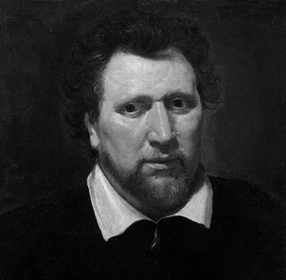
Jonson was, well, kind of solipsistic—this is mostly about him as a father and a poet, even to the point of making his son’s epitaph a teaser for the poem. Shakespeare is considerably less obvious in his exploration of grief. The father grieving for a lost son wrote a drama about a son grieving for a lost father.
The film Hamnet fictionalizes a long-held tradition that the play Hamlet was named for his son Hamnet. (Some modern scholars debate this, but come on.) Let me quickly (without too many spoilers, I hope) summarize the story. Agnes is a nature-loving girl in Stratford, who reveres her late herbalist mother, and is currently neglected by her affluent father and stepmother. Will, the son of a local (and abusive) glovemaker, is tutoring her younger brothers while apprenticing with his abusive father, a glovemaker. They meet and fall in love, or lust at least, and soon they are married with a daughter and twins (a boy and a girl).
They are, like so many couples, opposites. She is heart, he is head. She devotes herself to the natural world, and he immerses himself in literature and philosophy. She is country, and he becomes city. When she realizes he feels desperately imprisoned in their rural area, she sacrifices her own desire for an intact family and encourages him to go to London where he can write and act in plays.
He returns occasionally and is the fun absentee dad, while she raises the children. Then Hamnet falls ill and dies (probably of the plague). Will arrives too late. Agnes’s grief is overwhelming, elemental, and she cannot understand Will’s more restrained response. Eventually he returns to London, and Agnes cannot forgive him for this desertion, but also for not sharing her grief.
A year or so later, she receives word that her husband is producing a play titled Hamlet, and she is enraged, believing that he is exploiting their son’s name. With her brother, she travels to London to confront Will. She finds her way to the Globe Theatre, and sees the first performance of the play. As she sees the young man playing Hamlet, almost like her son grown up (the Hamlet actor is actually the older brother of the boy who played Hamnet—how cool is that?), her fury dissipates. And the very last moment, I won’t spoil. It’s extraordinarily moving.
Questions of Ethics and Emotions
Now the film collapses the timeline for dramatic purposes. Hamnet died in 1596, and Shakespeare wrote the play probably in 1599. But in the film, Shakespeare returns to London after the burial, and writes the play within the next year.
This compression of time is an effective way to show a connection between two events. Now this is an example of what might be considered manipulation, suggesting that the child’s death had the almost immediate result of the play’s creation. In my plotting courses, I suggest sequencing story events so that cause and effect are closely linked in time, even if in real life they aren’t always so congruent. This is more dramatic, and more likely to elicit emotion in the audience.
Is that manipulation? Yeah. It’s like punching the audience twice in a row and then kicking them when they’re down. But is it effective? Yeah. Is it fair? Ummm….
Well, this is going on so long! Let me break here and come back next week to discuss the ethical and creative issues. I’ll just pose the question: Is “manipulation” bad if it works? Does the end justify the means?
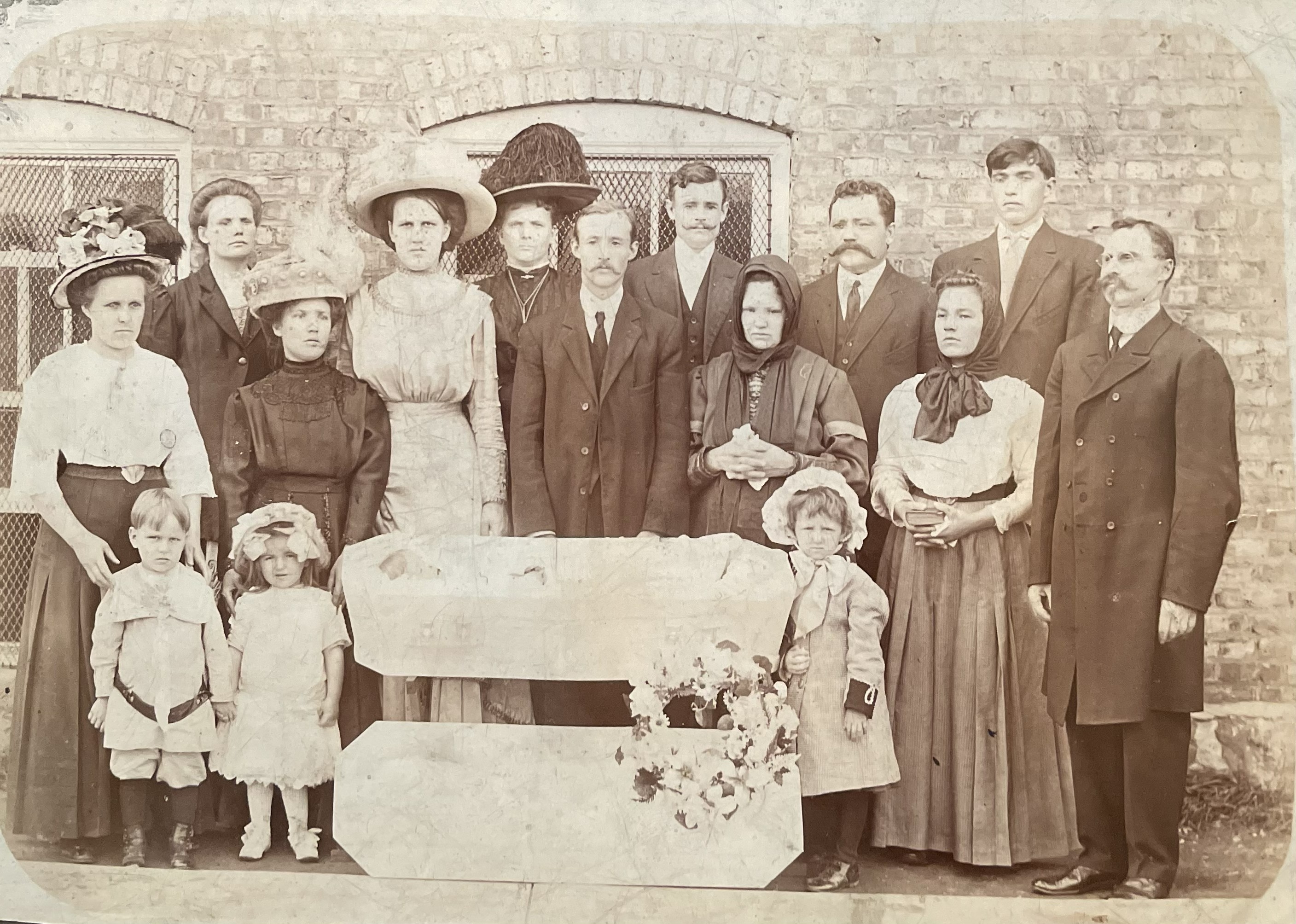
I’ll leave you with this photo which I’ll explain next week. This might look like it’s from some 19th Century Transylvanian village. But actually it’s of a child’s funeral in about 1914 Chicago, and the little girl to the right of the coffin is my grandmother Alice Pustek.