Preamble
I once heard a local on a Spanish bus proclaim, as we topped a hill, and Barcelona in all its then hundred square miles and three-and-a-half million inhabitants spread out before us, “Es mi pueblo!” My local town is no competition, but it is my “village,” my pueblo, even if tone-deaf founders endowed it with the clanking name of “Townsville,” which I more often shorten to The Ville. This is a series of (brief) blogs about some flora you may chance upon in The Ville during a calendar year.
In my capacious state of Queensland, “The Ville” lies far north of the capital, Brisbane, and still well north of Capricorn, the official tropical zone marker, but though it’s now abundantly endowed with palms, The Ville sports no tropical rainforests or overflowing waterfalls. In fact, The Ville belongs in the category of Dry Tropics – that is, its rainfall is a long way from the heavy average needed to naturally support such delights.
Nevertheless, The Ville does have an abundance of flora, native or imported, and no months show them off quite so well as November and December, the last of our spring and first of summer. For The Ville, the traditional four-season year cycle is not only inverted, at least if you live in the northern hemisphere, but also sways in and out of sync with the native seasonal cycle. And that has only two parts, the Dry, and the Wet. The Wet runs optionally from November to February, the Dry has the rest.
Red Flower Month, December
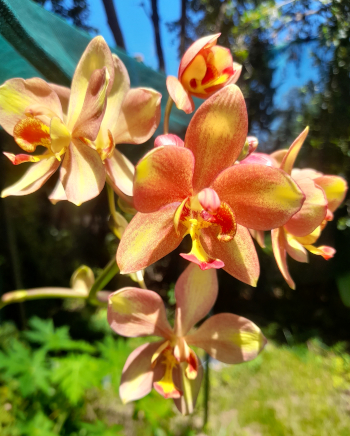
This year, spring-summer have arrived on time, but The Wet is late. Possibly in consequence, November-December have been particularly notable for the local red-flowering flora, native or otherwise. The first up here is an import, found in a good number of local gardens, including mine, traded to and from locals, under a variety of names. The proper name is “African blood lily,” but in tribute to its looks, which are anything but bloody, I personally call them “fire lilies.”
Like several other species, they are bulbs which, like tulips and daffodils, work as “die-backs.” Daffodils etc hibernate for winter. Fire lilies have evolved to deal with Dry-Wet cycles. In the “Dry,” of autumn and winter, water them how you like, they lose their leaves and hibernate.
Others of these species only come back to life after the first actual rains, storms or other good falls, of the early Wet. Fire lilies can be artificially triggered to flower, within reason, when you want them. This year I started watering mine in mid-October, and by the end of November, I had been rewarded with these:

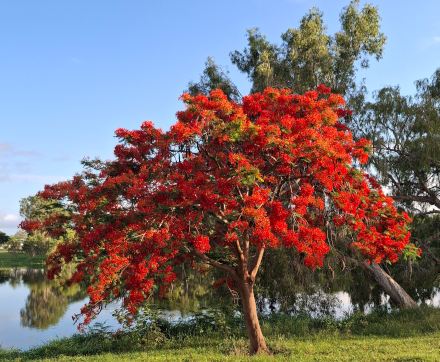
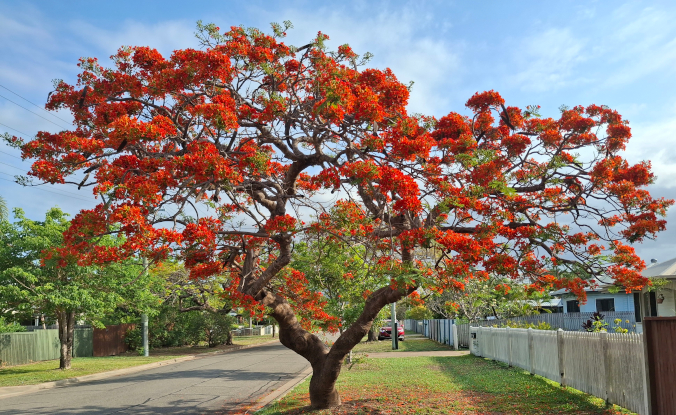
Even more spectacular this year have been the poinciana trees. Originally natives of Madagascar, they are now being slowly phased out in The Ville, partly because they don’t deal well with cyclones, and partly because their roots can play havoc with urban plumbing. But in days past they were planted galore, in both streets and gardens, and their brilliant flowers are the equivalent of holly in the Christmas run-up for The Ville. Here’s a close-up of the flowers,
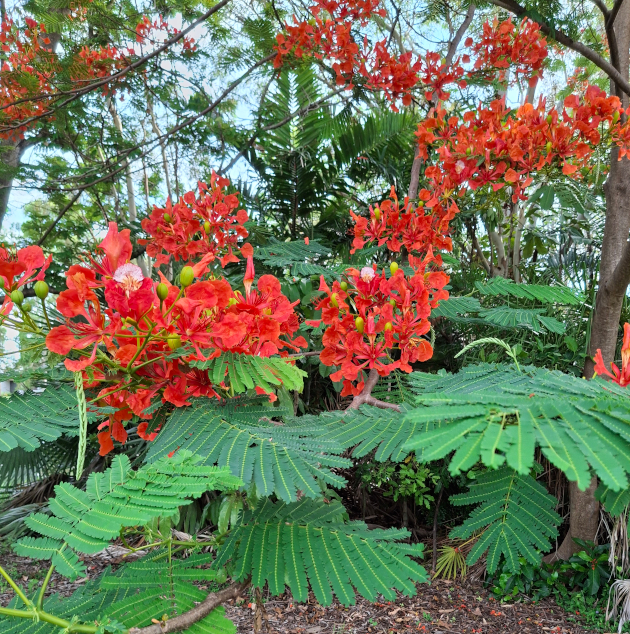
then a shot of a very nicely shaped specimen down in the groomed parkland by the river,
and finally, a veteran, still going strong on beside one of the older suburban streets.
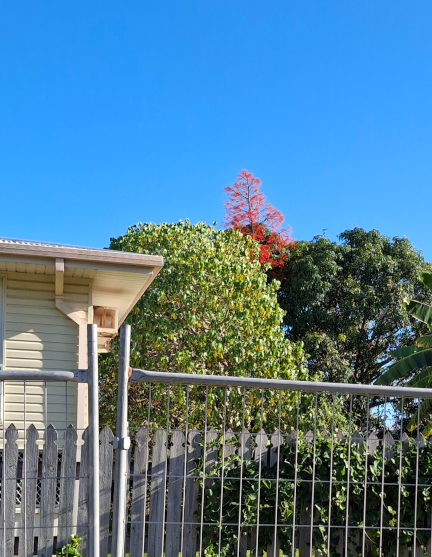
The final for the red-flower season is an Australian native, but not local to The Ville. This year, though, they are everywhere. Where the poinciana’s habit is low and spreading, the Illawarra Flame Tree (aka Flame Bottletree) likes to grow tall and pointed and almost like a traditional Christmas conifer. They also begin their spring-summer cycle by dropping their old leaves, and then they flower. All over. The first one here started in October, but there are still some just coming out. Like the poincianas, they appear everywhere, on street sides, like this one,
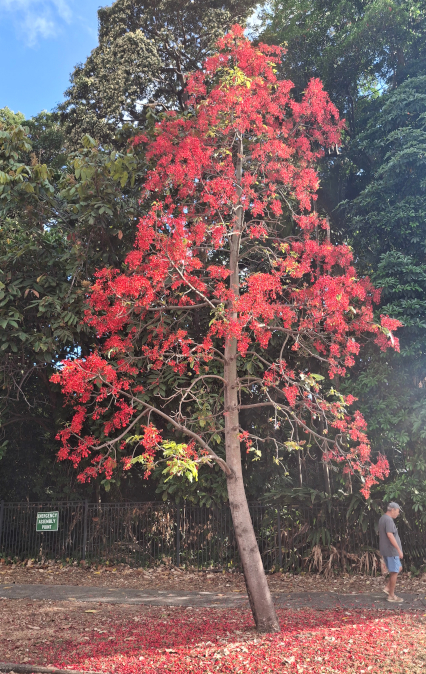
or just planted in somebody’s yard and bursting exuberantly through other trees’ foliage to proclaim the opening of summer, the height of the southern hemisphere tropical year.