
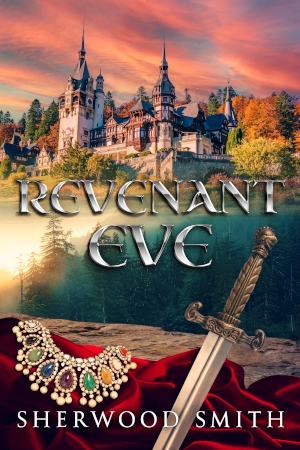
 Revenant Eve
by Sherwood Smith
On the eve of her wedding, Kim finds herself sent to Napoleonic times to guide a future queen halfway across Europe to save a kingdom …
Kim is getting ready for her wedding, and her new change of state—she can’t get used to the idea of being a princess—when she goes through the wrong door, and is caught in a vision. It’s 1795, the rise of Napoleon, and Kim is now a guardian spirit for a twelve-year-old kid who will either become Kim’s ancestor . . . or the timeline will alter and Kim will vanish, along with the small, magical European country of Dobrenica. Aurelie de Mascarenhas must get to Dobrenica, or more than just one family will vanish.
Kim hates time travel conundrums, and knows nothing about kids. How is she going to spirit-guide a kid born on Saint-Domingue, with whom she has nothing in common?
From Jamaica to England to Revolutionary Paris of the early 1800s, Kim and Aurelie travel, sharing adventures and learning more about Vrajhus, the Blessing, and the Nasdrafus than is known in Dobrenica’s modern times. Along the way to wedding bells or annihilation, Kim makes a shocking discovery . . .
Dobrenica Book 3
REVIEW
A nicely surreal visit to an otherworld…an interesting jaunt through a bit of history and quite satisfying.
-Locus
____
Sherwood Smith writes fantasy, science fiction, and historical romance.
One
THE JOURNALIST POISED HER PENCIL in the air and looked at me expectantly. “So, Mademoiselle Dsaret—ah, Murray, how does it feel to know that in a month and a half you will become a princess?”
Like living at Disneyland, I wanted to say, but there was a fifty-fifty chance that my interviewer had never heard of Disneyland.
In so many ways, Dobrenica is still a century (sometimes more) behind modern times. Madam Waleska, who ran the inn where I’d stayed during my first two visits, had once insisted with genuine horror that I could not possibly be an American because I didn’t spit on the floor. That particular rumor dated back to Mrs. Trollope’s Domestic Manners of the Americans, written in 1832, but to the Dobreni it may as well have been posted on the Internet last week. Not that you can access the Internet in Dobrenica. You can’t. Cell phones don’t work, either. Land lines work…most of the time.
Here was this question, put to me from Annika, an earnest young woman barely college age, on assignment for the Dobreni newspaper. A weekly. Judging by her rigorously polite manners, I guessed that this was her first assignment. We sat in a little café in the center of town that was, judging from the architecture, about three hundred years old. Practically new, for Dobrenica.
The editor of the newspaper was probably being modern by sending a woman to interview me. I wondered if Annika was the first, possibly the only, woman on the staff. But then the newspaper itself had a spotty history, free speech in the printed media being a relatively new concept. From the days of World War II until relatively recently, Dobrenica had been under German and then Soviet control. Before then, it had been at least nominally a part of the Hapsburg Empire.
For the Dobreni, the prospective return to monarchy was progress.
To me—Los Angeles born and raised—it seemed weird.
And the idea of being a princess made me feel really weird.
“First of all, you can call me Kim. It’s true my first name is Aurelia—I was named for my grandmother—but it will be relegated to official purposes only. I never use it. To answer your question, what does it feel like?” I practiced my princessy smile. My teeth felt cold, and I had a nasty feeling my smile looked as real as a three dollar bill. “I’ve been so busy that I haven’t had a chance to figure out how I feel,” I said, wondering how diplomacy differed from outright lying. “This is what I can tell you, how wonderful it is to find myself in Dobrenica again, and how beautiful everything is.”
And I gushed on, praising everything from the royal palace (I was still trying to get my head around the fact that I would actually be living in one) to the historic sites (in Dobrenica, pretty much everything is a historic site), to the shops along St. Ladislas Street, the Rodeo Drive of Dobrenica.
The way Annika slowly relaxed gave me hope that even if my words were boring, they assured her that I was not going to chop her into bits and serve her for breakfast. For her, my imminent rank had historical gravitas, even if it felt like a fairy-tale to me.
When I ran out of things to burble about, Annika’s dark gaze narrowed. She squared herself a little on her chair.
I glanced at her small pad of paper, on which she’d written down about five words of my diplomatic burble. Here come the real questions.
“There are so many conflicting rumors about how you found your way here from the United States,” she said.
I’ll bet there are. “I’ve heard a few.”
She flashed me a tentative smile, then pressed her pencil to the paper.
“How did you meet the Statthalter?” Her tone was as neutral as her use of the technically correct title for my fiancé, Marius Alexander Ysvorod, shortly to be officially recognized as Crown Prince of Dobrenica. Correct, that is, during the bad old Soviet days, when Milo, Alec’s father, had the title.
He was just a young teen when he joined his father in running a kind of shadow government and black market social services. Toward the end of those days the Soviets no longer put much energy into thwarting them, and even permitted elections. When his father’s health began to fail, Alec was voted Statthalter, a suitably unmonarchical-sounding title.
As the Soviets began to leave by degrees, the five traditional ruling families began to pick up their ancestral duties—and privileges. Especially the von Mecklundburgs, and in particular the Duchess and her son Tony.
“The Statthalter found me by accident,” I said. “Or maybe it wasn’t so accidental. I was in Vienna, at the Hofburg—the imperial palace. I saw what I thought was someone dressed in eighteenth century clothes, and followed her, but she turned out to be a ghost. Queen Sofia, in fact.”
In any other part of the world, the mention of following ghosts would net you, at best, the kind of glance usually reserved for the roach you just discovered in your half-eaten salad. But here? She gave me a cautious nod, and said, “She was a Vasa from Sweden. Very famous in Dobrenica.”
“Well, while I was following Queen Sofia’s ghost, one of the Statthalter’s people saw me and thought I was the Statthalter’s fiancé, Ruli von Mecklundburg, who had gone missing.” Kidnapped by Tony, her own brother, in fact. “He told the Statthalter, who…realized I must be a relation and offered to take me to Dobrenica.”
Okay, here I was really stretching things, because the truth is that Alec kidnapped me. And stuck me on a train to Dobrenica, thinking I was Ruli, who must be playing a devious game devised by Tony. Because Tony really likes games.
But I escaped. When Alec caught up with me, the truth hit us both equally hard: I wasn’t Ruli, who turned out to be my second cousin in a family I had not known existed.
“I remember some thought she was you, or you were she.” Annika’s Dobreni had a Russian flavor that made me wonder if she came from one of villages on Devil’s Mountain, deep in the heart of von Mecklundburg territory.
“People mistook me for her,” I said, not adding that it had been Alec’s idea to take advantage of the resemblance, in order to force whoever was holding Ruli out into the open. I’d gone along with it, not because I cared squat for Dobreni politics (at that time) but because it sounded like fun. Adventurous. And I was attracted to him. “It turned out that Ruli was up on Devil’s Mountain all along. Tony was a count then then, was having some trouble with a mercenary captain.” Her eyes widened at my casual reference to Tony, AKA Duke Karl-Anton von Mecklundburg.
“A Captain Reithermann,” Annika said, nodding. “Wanted through half of Europe.”
Hired by Tony to facilitate his coup d’état. Reithermann had also had a rap sheet a yard long in the States.
“The Devil’s Mountain people believed that this Reithermann was trying to take over their mines,” she said.
It was Tony’s plan, I didn’t say. And he wasn’t only trying to take over the mines but the entire country, with his mother’s help.
I gave Annika that fake smile again. “Not just the mines,” I said.
Annika leaned forward. “And so you and Duke Karl-Anton fought Reithermann’s villains together, with swords? I always hoped that rumor was true.” The way she said Duke Karl-Anton was different from her carefully neutral, respectful mention of the Statthalter. Oh yes, I’d bet anything she came from Devil’s Mountain. Tony was extremely popular with the Devil’s Mountain people. The wilder he was, the more they seemed to like him.
“I did use my sword,” I said slowly. Should I add that we’d been enemies at the time?
My relationship with Tony was complicated, but his plan hadn’t worked. Alec had quietly and skillfully outmaneuvered him.
And Tony’s own mother had double-crossed him.
I said, “I did use my sword, but at the last moment before I could get away, I got shot in the shoulder.”
“But then you left the country?” she asked.
“Yes. I returned to California before the Statthalter and Ruli got married as planned. It was to bring peace and maybe even the Blessing.”
Like the mention of the ghost, the word Blessing caused a nod of comprehension. Not every Dobreni believes in ghosts, or magic, but they accept that many around them do. The Blessing is supposed to be magic, or Vrajhus, on a country-wide scale, removing Dobrenica from the world for a time that is contingent on peace among its people. Some believed that Vrajhus raised magical fogs to confuse invaders, sending them eventually the way they had come, and others that the country itself vanished to another, timeless realm called the Nasdrafus. The ability to magically vanish had not happened during the Soviets’ hold on the country, some said because of the increased tension and animosities. Now, Dobrenica badly needed its leading families to get along.
She said, “There are some, like Duke Karl-Anton, who believe that the days of the Blessing are past. If it ever really happened.”
“So much Dobreni history was destroyed during the twentieth century wars that it’s hard to know for sure,” I said. “But isn’t peace something to aim for anyway? I don’t just mean the country’s leader marrying on September second and maybe creating this magic, which no one seems to think is needed anymore, since the fall of the Iron Curtain. I mean the kingdom, from the five leading families down to the humblest shepherd, living in peace with one another, whatever their personal beliefs. That idea is worth striving for, whether magic exists or not.”
She nodded soberly. “I think everybody likes that idea. But whether the Nasdrafus really exists, that, some are skeptical about.”
I’d also been skeptical about the Nasdrafus, the magical realm, but my skepticism had been blasted by the discovery of ghosts, then of vampires, and then of the charms—magic—that kept vampires at bay.
She twirled her pencil. “Do you think the Blessing did not take place because the Statthalter was really in love with you, and Lady Aurelia was angry because of it?”
I sighed. “Ruli—Princess Aurelia then—wasn’t angry. She didn’t want the marriage any more than he did, but they felt constrained largely for political reasons. It was pretty much in name only. You know, they were married barely three months before the roadside accident that took her away.” Not the accident that killed her, because that would be a total lie. Ruli wasn’t even in the car. Nor was I going to say the accident that resulted in her being turned into a vampire. The von Mecklundburg family didn’t want that known.
Annika wrote fast. “The Statthalter was cleared of having driven her off the cliff, though it was his car. And everyone knows he was there.”
“He was asleep in the back seat. Nobody likes to say anything, out of respect for the von Mecklundburgs, but the fault lay with an old family connection.”
Annika surprised me with a knowing look. “Everyone on Devil’s Mountain knows about Jerzy von Mecklundburg. He did not have a good reputation even in my grandmother’s day. And so this accident brought you back to Dobrenica?”
Actually, it was Ruli’s appearing to me after the accident that got me back to Dobrenica. Thinking she was a ghost, I’d come back to help her, stayed to help Alec, and here I was.
I said, “Yes,” because it was simpler.
After that, the questions were easy stuff: details about the wedding, from the decorations—made up mostly of roses from centuries-old gardens, bred for their vampire-warding properties—to the veil I’d wear, which had been hidden away by my grandmother’s governess before the Germans rolled over the border in WW II.
The interview ended on a friendly note. I heaved a sigh of relief as I walked past the new opera house that had been the royal military school four centuries before. I cut across St. Ladislas Street and headed uphill toward Sobieski Square, beyond the Cathedral, whose great belltower served as a navigational landmark.
It was mid-July. In Los Angeles, taking a stroll in summer’s simmering heat and smog wasn’t much fun, but here in Dobrenica’s mountains the air was warm in the sun, yet cool in the shadows of the old buildings.
Each morning I walked to the palace to see Alec, who quite properly bunked there, in order to oversee the reconstruction as well as to keep governmental things going.
Occasionally people waved at me, another thing I’d found it difficult to get used to. I was instantly recognizable, and not because tall blondes are so unusual. It was my resemblance to Queen Sofia, whose portrait hung in the royal gallery. She’d brought most of my physical features to the Dsaret family when she’d married the king, and they’d been handed down to her descendants.
My crooked smile, though? The one that I shared with my mom and with Tony, that came from another relative entirely.